A direct cremation in South Africa generally costs between R5,000 and R8,000, and a cremation with a full service generally costs between R8,000 and R22,000. This guide breaks down every charge — the crematorium fee, the coffin, the urn, transport and the paperwork — so you can see exactly what you are being quoted for.
If you are reading this while making arrangements, here is the short answer first. A direct cremation — cremation without a funeral service — generally costs R5,000 to R8,000 in South Africa. A cremation with a service, once you add the coffin, the venue, transport, programmes and catering, generally lands between R8,000 and R22,000. Everything below explains what sits inside those numbers and where families are most often surprised.
The ranges on this page are the same ranges published in our South African funeral cost breakdown, gathered from funeral homes across Gauteng, KwaZulu-Natal, the Western Cape and Limpopo. They are a planning guide, not a quote. Crematorium tariffs and funeral home mark-ups differ widely, so always ask for a written, itemised quote before you sign anything.
What a cremation costs in South Africa
A cremation bill is not one number — it is a stack of separate charges, and only one of them is the actual cremation. This is the line-by-line picture:
| Item | Low | High | Notes |
|---|---|---|---|
| Crematorium fee | R3,000 | R8,000 | The cremation itself. Municipal crematoria are usually cheaper than private ones. |
| Body care and documentation | R3,000 | R6,000 | Collection, preparation, storage and the paperwork the funeral director files for you. |
| Coffin or cremation container | R1,500 | R4,000 | A chipboard or flatpack coffin is the standard choice for cremation. |
| Urn | R300 | R3,000 | A basic container is normally included; decorative urns are extra. |
| Hearse and transport | R2,000 | R8,000 | Distance-dependent. Long-distance transport within South Africa costs more. |
| Venue or chapel hire | R0 | R5,000 | Many churches do not charge for members. Crematorium chapels often charge per slot. |
| Programmes and printing | R500 | R3,000 | Roughly 100 folded A5 copies in full colour. |
| Catering | R3,000 | R20,000+ | Entirely guest-count dependent, and often the largest single line. |
| Direct cremation (no service) | R5,000 | R8,000 | The most affordable option available in South Africa. |
| Cremation with a service | R8,000 | R22,000 | Typical all-in total for a full-service cremation funeral. |
The crematorium fee is often the smallest part of the bill. Catering, the coffin and transport routinely cost more than the cremation itself. If your budget is tight, that is where the room to move actually is.
Direct cremation: the most affordable option
A direct cremation means the body is collected, the paperwork is completed, and the cremation takes place without a viewing, a chapel service or mourners present. The ashes are returned to the family afterwards.
At R5,000 to R8,000, it is the cheapest lawful way to arrange a funeral in South Africa. It is worth saying plainly: choosing it is not a failure of respect. Many families arrange a direct cremation and then hold a memorial service weeks later, at a church hall or at home, once relatives can travel and the household has had time to breathe. That order — cremation first, service later — often costs less and gives the family more control over the day.
Cremation with a service
This is the more familiar arrangement: a service at a church, a chapel or the crematorium, followed by the cremation. The cremation charge does not change. What changes is everything around it — the coffin the mourners see, the venue, the programmes, the flowers, the sound system and the meal afterwards.
Families are most often caught out by the gap between the funeral home's quoted "cremation package" and the final bill. A package price frequently covers body care, a basic coffin and the crematorium fee, and nothing else. Ask specifically which of the lines in the table above are not included.
The coffin: you do not need an expensive one
A coffin is required for cremation, but it is consumed in the process. Spending R20,000 on a solid hardwood casket that will be cremated is a decision some families make for the sake of the viewing, and that is entirely their right — but it should be a decision, not an assumption.
Most South African cremations use a chipboard or flatpack coffin at R1,500 to R4,000. Some funeral homes also offer a rental casket: a good-quality casket used for the service, with a simple inner container that goes to the crematorium. If appearance at the service matters to your family, ask whether that option exists — it can save several thousand rand.
Our guide to coffin and casket prices in South Africa covers the materials, the price bands and what actually drives the cost.
Urns, ashes and what happens afterwards
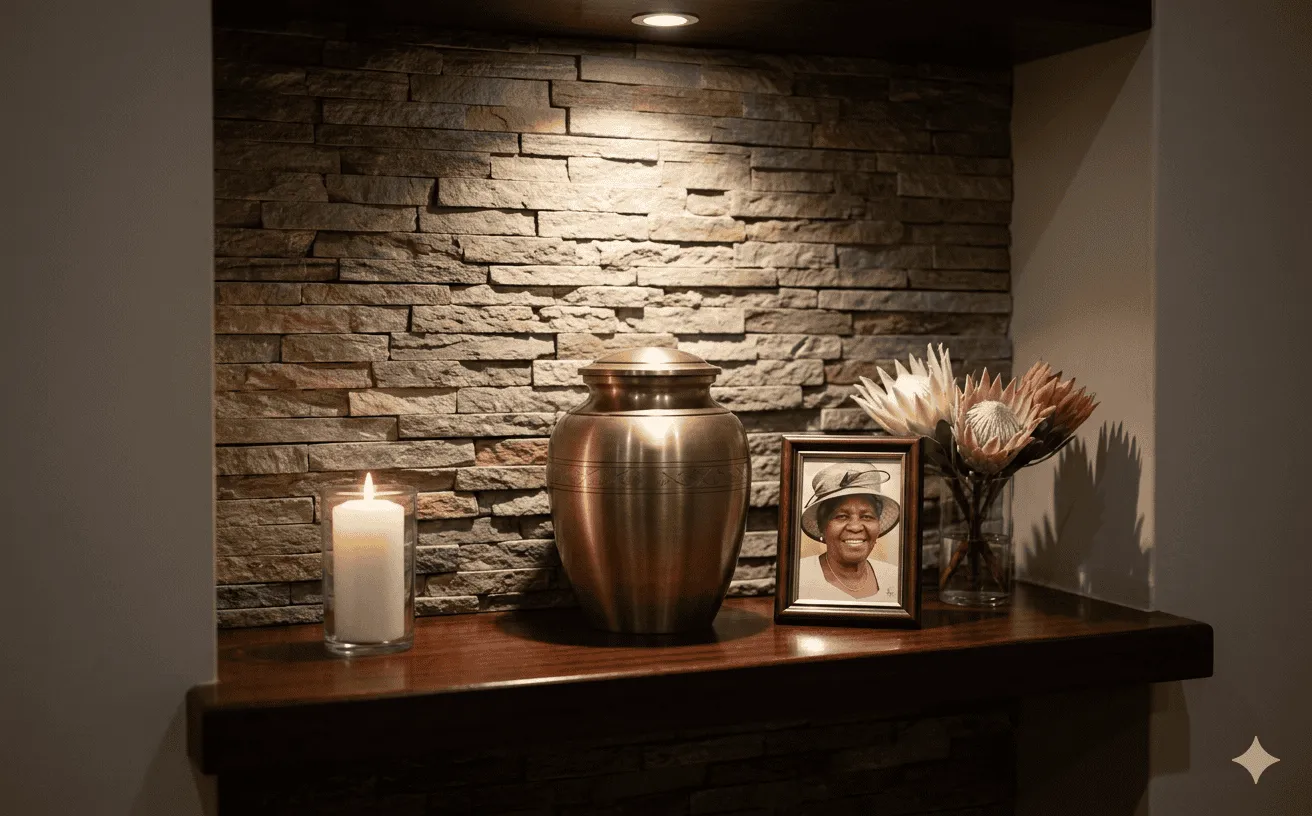
Ashes are normally available within a few working days of the cremation, and the crematorium will tell you when to collect or arrange delivery. A plain container is generally included; decorative urns run from about R300 to R3,000 depending on material.
Families in South Africa keep ashes at home, bury them in an existing family grave, place them in a niche at a wall of remembrance, or scatter them somewhere meaningful. Municipal crematoria and memorial parks usually offer a garden of remembrance or a niche wall for an additional fee — ask for that tariff separately, because it is rarely quoted upfront. If you plan to scatter ashes on land you do not own, get the landowner's permission first.
Documentation: what is legally required
Every death in South Africa must be reported to the Department of Home Affairs. In practice your funeral director handles almost all of this, but it helps to know what is moving:
- A notification of death (form DHA-1663), completed with a medical certificate of the cause of death from a doctor.
- The death is then registered and Home Affairs issues a burial order, which is required before either a burial or a cremation may take place.
- Cremation requires additional authorisation beyond the burial order — typically an application for cremation signed by the next of kin, plus a certificate from the doctor who attended the deceased. Because cremation cannot be undone, crematoria apply stricter medical certification than burial does.
The exact forms differ between crematoria and municipalities, so ask your funeral director which ones apply and who has to sign them. If the death was unnatural or has been referred to a state mortuary, the cremation cannot proceed until the forensic process is complete and the body is formally released — that can add weeks, and it is the single most common cause of delay.
Share the service details in one link
A TributePoint memorial page carries the cremation service details, the livestream and the photo tribute — so family who cannot travel can still be part of the day. Creating one is free.
Create a Free Memorial PageCremation vs burial: the cost difference
Cremation is almost always cheaper than burial in South Africa, and the reason is structural rather than incidental: cremation removes the burial plot, the grave digging and the tombstone from the bill entirely. Those three items are where burial costs escalate.
| Category | Burial | Cremation |
|---|---|---|
| Body care and documentation | R3,000 – R6,000 | R3,000 – R6,000 |
| Coffin | R3,000 – R25,000 | R1,500 – R4,000 |
| Plot or cremation fee | R1,500 – R50,000 | R3,000 – R8,000 |
| Grave digging | R800 – R3,500 | Not applicable |
| Tombstone | R3,000 – R25,000 | Not applicable (urn R300 – R3,000) |
| Typical total | R15,000 – R60,000+ | R8,000 – R22,000 |
Cost is not the only factor, and for many South African families it is not the deciding one. Cultural and religious expectations around burial run deep, and a decision that saves money but breaks faith with the family's traditions is rarely the right one. Our burial vs cremation guide works through the cultural, religious and practical side of that choice in full.
Why prices differ so much between areas
There is no national cremation tariff in South Africa. Prices are set by individual crematoria — some municipal, some private — and then marked up by the funeral home arranging the service. Three things drive most of the variation:
- Metro vs rural. Johannesburg, Cape Town and Durban sit at the higher end of every range on this page. Smaller towns are generally lower.
- Crematorium access. Crematoria are concentrated in the major metros. If the nearest one is far away, the transport line grows quickly, and in some provinces that alone makes cremation impractical.
- Municipal vs private. A municipal facility is usually the cheaper option where one is available and has capacity.
How to reduce cremation costs
- Get three written quotes. Quotes for an identical cremation can differ by 50% or more between funeral homes in the same city. This is the single most effective thing you can do.
- Ask for the itemised list, not the package price. Under the Consumer Protection Act you are entitled to an itemised price list before you sign a contract.
- Ask whether the crematorium is municipal. Where a municipal facility is available it is typically the cheaper route.
- Choose a cremation coffin, not a display casket — or ask about a rental casket for the service.
- Consider a direct cremation now and a memorial service later. Separating the two almost always costs less, and it gives distant family time to travel.
- Use a digital programme and a shared link instead of printing hundreds of booklets and paying for a newspaper notice.
- Let the community cater. In most South African communities communal catering is expected and offered. Accepting it is not a loss of dignity.
A funeral home may not hold a body as leverage for an unpaid bill — that is unlawful. You are also entitled to an itemised price list before signing, and you are not obliged to buy every item from the funeral home arranging the service.
Questions to ask before you commit
- Is this quote itemised, and what specifically is not included?
- Which crematorium will be used, and is it municipal or private?
- Is the crematorium fee passed through at cost, or marked up?
- What coffin is included at this price, and may we supply our own?
- Is an urn included, or charged separately?
- How many days until the ashes are available, and is delivery extra?
- What are the charges for a niche or garden of remembrance?
- Which documents do you handle, and which do we need to sign in person?
- What happens to the price if the cremation is delayed?
Planning the service itself
Whether you hold the service before the cremation or weeks afterwards, the practical problem is usually the same: family are spread across provinces and countries, and not everyone can be in the room. A memorial page solves a surprising amount of that. It holds the service details, the obituary, the photo tribute and — if you want it — a livestream, all behind one link you can send on WhatsApp. It also means you do not have to print a booklet for everyone who might attend.
If you are at the very beginning of this and not sure what happens next, start with what to do when someone dies in South Africa, which walks through the first calls, the paperwork and the timeline step by step.
Frequently Asked Questions
How much does a cremation cost in South Africa?
A direct cremation — cremation without a service — generally costs R5,000 to R8,000. A cremation with a full funeral service generally costs R8,000 to R22,000 once the coffin, venue, transport, programmes and catering are included. The crematorium fee itself is usually R3,000 to R8,000.
Is cremation cheaper than burial in South Africa?
Yes, almost always. A typical cremation totals R8,000 to R22,000 against R15,000 to R60,000 or more for a burial. The difference comes mainly from the burial plot, the grave digging and the tombstone, none of which a cremation requires.
What is the cheapest cremation option in South Africa?
A direct cremation, at roughly R5,000 to R8,000. The body is collected, the paperwork completed and the cremation carried out without a chapel service. Many families then hold a memorial service later, which usually costs less overall and gives distant relatives time to travel.
Do you need a coffin for a cremation?
Yes, a coffin or approved container is required. It does not need to be an expensive one — most South African cremations use a chipboard or flatpack coffin costing R1,500 to R4,000. Some funeral homes also offer a rental casket for the service with a simple inner container for the cremation itself.
What paperwork is needed for a cremation in South Africa?
The death must be reported to Home Affairs using a notification of death (DHA-1663) supported by a medical certificate of cause of death, after which a burial order is issued. Cremation requires further authorisation on top of that — normally an application signed by the next of kin plus a certificate from the attending doctor. Your funeral director handles most of it; ask which forms apply at the specific crematorium.
How long does it take to get the ashes back?
Ashes are usually available within a few working days of the cremation. The crematorium will confirm when they can be collected, and some funeral homes will deliver them for an additional fee.
Why do cremation prices differ so much between areas?
There is no national cremation tariff. Each crematorium sets its own fee and each funeral home adds its own mark-up. Metro areas sit at the higher end of the range, municipal facilities are usually cheaper than private ones, and if the nearest crematorium is far away the transport charge grows quickly.