When someone you love dies, you are expected to make dozens of decisions — most of them unfamiliar — while processing one of the hardest emotions a person can experience. This guide walks you through everything that needs to happen, in order, so that you can focus on your family while knowing that nothing important is being missed.
- Make the first calls — a doctor, the police if the death was unnatural, and close family.
- Contact a funeral home within about 24 hours so the body can be collected.
- Register the death at Home Affairs — within 72 hours; your funeral director usually files this.
- Notify family, friends and the community, ideally with one link everyone can share.
- Plan the service — burial or cremation, date, venue, programme, catering.
- Work out the costs and what any policy or society will actually pay.
- Report the estate to the Master of the High Court and close or claim accounts.
- Look after your family and yourself once the funeral is over.
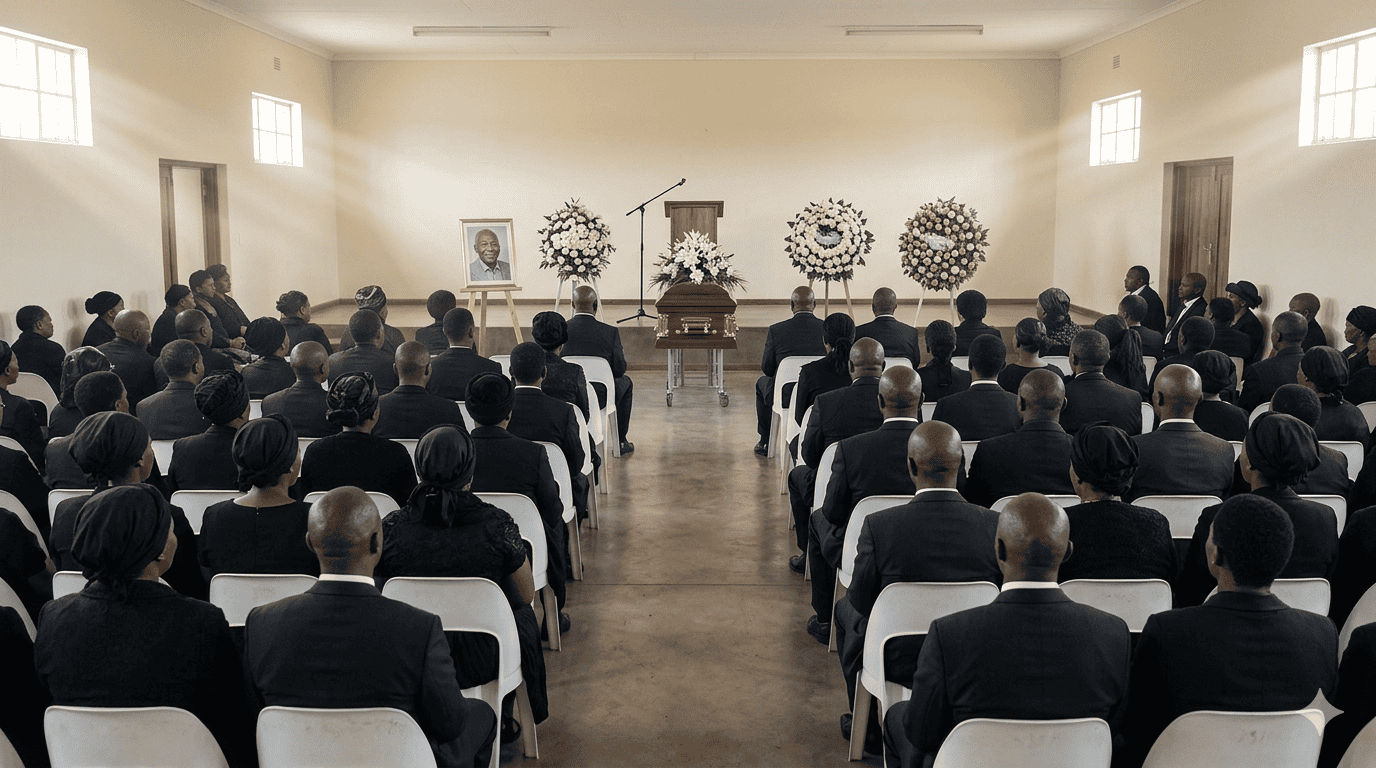
Every year, approximately 500,000 deaths are registered in South Africa according to Statistics South Africa. Behind each of those numbers is a family navigating paperwork, costs, cultural obligations, and grief — often simultaneously. Whether the death was expected after a long illness or came without warning, the steps you need to take are largely the same. What changes is how much time you have to take them.
Step 1: The First Phone Calls (Within Minutes)
The very first thing to do depends on where the death occurred. Each situation has a slightly different starting point:
If the person died at home
Call 10177 (emergency medical services) immediately. Paramedics will attend to confirm that the person has passed. If the death was unexpected or the cause is unknown, you must also call the South African Police Service (SAPS) on 10111. A police officer will need to visit the scene and issue a case number. This is not an accusation — it is a legal requirement for all unattended deaths in South Africa under the Inquests Act 58 of 1959.
If the person died in hospital or a care facility
The attending doctor or facility staff will confirm the death and begin the medical documentation. A nurse will usually contact you. Ask for the name of the doctor who will complete the Notice of Death (Form BI-1680), because you will need to follow up on this document.
If the person died in a car accident or from a crime
The police will manage the scene. A post-mortem examination (autopsy) will be required before the body can be released to the family. This can delay funeral arrangements by several days to several weeks. The state mortuary will hold the body during this time at no cost to the family. Contact your nearest SAPS station for updates using the case number given at the scene.
Do not move the body yourself. In South Africa, only registered funeral homes and emergency medical personnel are legally permitted to transport human remains. Attempting to transport the body privately can result in legal complications.
Step 2: Contact a Funeral Home (Within 24 Hours)
Once the death has been confirmed, you will need to contact a funeral home. The funeral home takes over the care of the body and begins the formal process of documentation. You do not need to choose the first funeral home that arrives at the hospital or scene — you are legally entitled to choose your own provider.
South Africa has thousands of registered funeral homes, from large national chains like AVBOB and Doves to smaller independent operators in every township and town. Ask for an itemised price list before signing anything. You are not obligated to take a full-service package — many families choose only body care and documentation from the funeral home, and handle catering, flowers, and the programme themselves.
If the deceased had a funeral policy or burial insurance, contact the insurer immediately. Many funeral homes can work directly with insurers, but you should confirm coverage amounts before agreeing to a package. According to the Financial Sector Conduct Authority (FSCA), funeral policy claims should be processed within 48 hours of submitting all required documents.
If the deceased belonged to a stokvel, burial society, or church savings group, notify them immediately. Many of these groups provide financial assistance or practical help (cooking, transport, setting up the venue) within hours of being informed.
Step 3: The Death Must Be Registered at Home Affairs (Within 72 Hours)
South African law requires that every death be registered with the Department of Home Affairs (DHA) within 72 hours. This is not optional — without registration, no burial order will be issued, and the funeral cannot proceed.
The registration process works as follows:
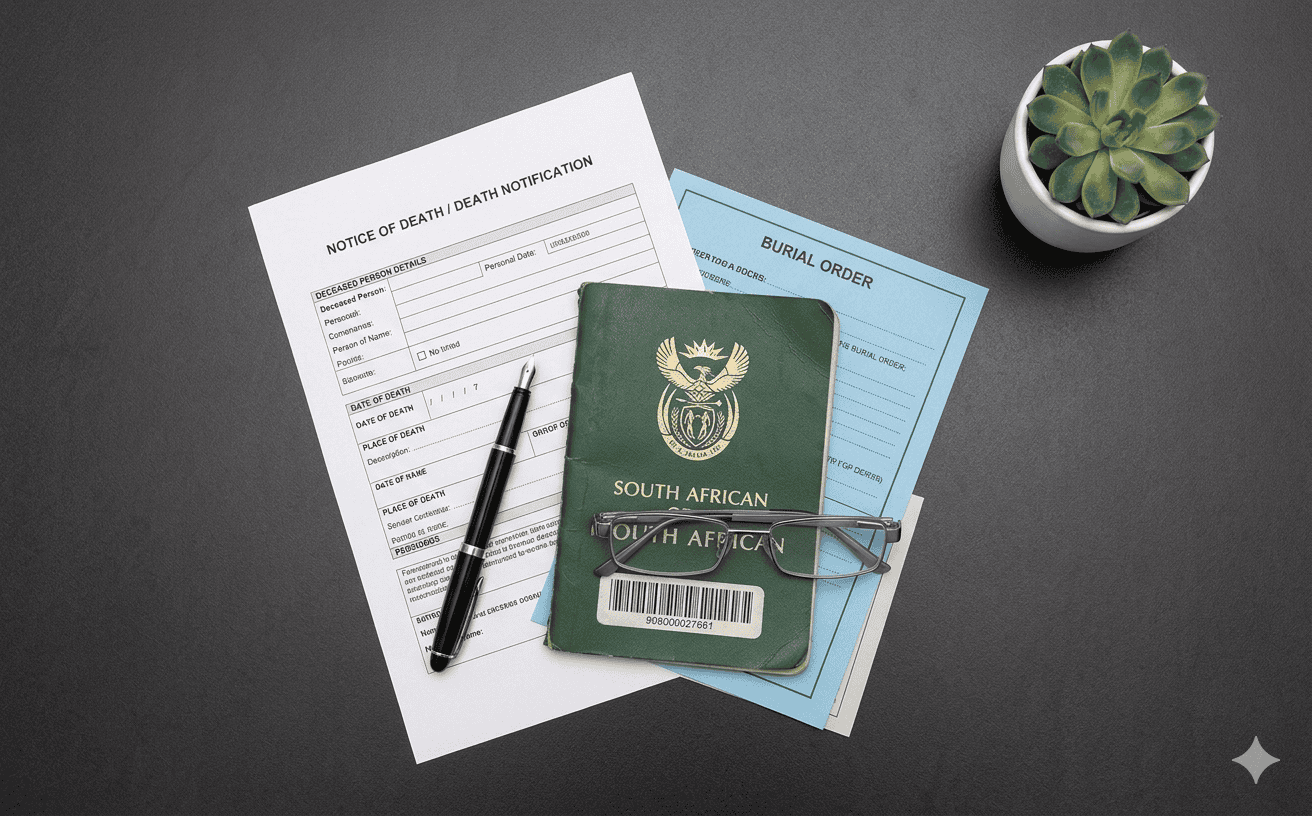
- The doctor completes the Notice of Death (BI-1680). This form records the medical cause of death and must be signed by the doctor who examined the body. If a post-mortem is required, the forensic pathologist completes it instead.
- The funeral home submits the BI-1680 to Home Affairs. Most funeral homes handle this on your behalf. They will also submit the deceased's ID document (or a certified copy) and their own registration documents.
- Home Affairs issues the Death Certificate (BI-1663). This is the official record of the death. You will need multiple certified copies — for the estate, for insurance claims, for the bank, and for the employer. Request at least 5 certified copies immediately.
- Home Affairs issues the Burial Order. The burial or cremation cannot take place without this document. The funeral home will collect it and confirm that all paperwork is in order before the funeral date.
If the 72-hour window is missed — which can happen if a post-mortem is ordered or if documents are delayed — a late registration can be done, but it involves additional forms and may take longer. Your funeral home can advise on this process.
Step 4: Notify Family, Friends, and Community
Once the immediate family has been told in person or by phone — which should always happen before any public announcement — you need to reach a much wider circle: extended family, colleagues, neighbours, church members, old school friends, and community networks.
In South Africa, this used to mean newspaper death notices, phone trees, and physically visiting people's homes. Today, most families use WhatsApp to spread the word — but this creates its own problems. Messages get forwarded with incorrect dates, venues change but the old message keeps circulating, and you end up answering the same questions from dozens of different people.
A better approach is to create a single digital memorial page that contains all the information in one place: who has passed, the obituary, the funeral date and time, the venue with a map, and any special instructions (dress code, parking, whether children are welcome). You share one link, once, and anyone who opens it sees the current, correct information.
If arrangements change — and they often do — you update the page and everyone sees the update the next time they open the link. No corrections to send, no confusion, no conflicting messages in different group chats.
Notify Everyone with One Link
Create a free tribute page on TributePoint with the obituary, funeral details, venue map, and a photo gallery — then share a single link via WhatsApp. Update it any time, and everyone sees the latest information.
Create a Free Tribute PageStep 5: Plan the Funeral Service (Days 2–5)
With the body in the care of the funeral home and paperwork underway, the family can focus on planning the funeral service itself. In South Africa, funerals are deeply significant events — often the largest gathering a family will organise — and cultural, religious, and community expectations all play a role.
Key decisions to make
- Burial or cremation? This may be determined by religious or cultural practice. Muslim and Jewish traditions require burial. Many Christian and traditional African families also prefer burial. Cremation is increasingly chosen in urban areas for practical or financial reasons.
- Where will the service be held? Options include a church, mosque, community hall, funeral home chapel, or the family home. In many rural areas, the service is held at the homestead.
- Who will lead the service? A pastor, imam, priest, or elder will usually officiate. Confirm their availability for your chosen date.
- Who will deliver eulogies? Choose 2–4 people who knew the deceased well from different parts of their life — family, work, church, community.
- What about the funeral programme? This printed booklet is a standard part of South African funerals. It typically includes the order of service, hymns, the obituary, and photographs. Budget R500–R3,000 depending on quantity and design.
Night vigil (umkhuleko / wake)
In many South African communities — particularly Zulu, Xhosa, Sotho, and Tswana families — a night vigil is held the evening before the funeral. Family and community members gather at the home to pray, sing hymns, and support the bereaved family through the night. Food is prepared and served by community women, and the gathering continues until the morning.
If you are attending a vigil, bring what you can — food, drinks, firewood in rural areas, or simply your presence. The vigil is not a formal event with a dress code; it is a communal act of support, and being there is what matters.
Step 6: Understand the Costs
Funeral costs in South Africa range from under R10,000 for a basic cremation to well over R50,000 for a full burial with all services. The wide range means that every family can find an arrangement that works for their budget — but only if you know what you are paying for.
Here is a realistic breakdown of common costs in 2026:
- Funeral home basic package (body care, coffin, transport, documentation): R5,000 – R20,000
- Burial plot (municipal cemetery): R1,500 – R12,000 depending on municipality
- Cremation (including service): R5,000 – R18,000
- Catering for after-tears: R3,000 – R15,000+ depending on numbers
- Funeral programme printing: R500 – R3,000
- Flowers: R500 – R5,000
- Tombstone (usually purchased later): R3,000 – R25,000+
- Newspaper death notice: R500 – R2,500 per publication
Insurance coverage varies widely. Check whether the deceased had a funeral policy through their employer, a private insurer (such as Old Mutual, Hollard, or Clientele Life), a stokvel, or a burial society. Many families discover multiple overlapping policies — all of which may pay out.
You are not legally required to buy a coffin from your funeral home. Independent coffin suppliers often charge 30–50% less for the same quality. Similarly, many families save thousands by handling their own catering, flowers, and programmes rather than adding these to the funeral home package.

Step 7: Handle Estate and Financial Matters (Week 1–3)
After the funeral, there are still important legal and financial matters to attend to. These should not be rushed, but they should not be ignored either — some have strict deadlines.
Report the estate to the Master of the High Court
Under the Administration of Estates Act 66 of 1965, every deceased estate must be reported to the Master of the High Court within 14 days of death. This applies regardless of whether the deceased had a will.
- If the estate is valued at under R250,000 and there is no property, it can be processed as a small estate using a simplified procedure at the local Magistrate's Court.
- If the estate exceeds R250,000 or includes immovable property, an executor must be appointed. If a will exists, the executor named in the will is usually confirmed. If there is no will, a family member can apply to be appointed.
Financial accounts and policies to close or claim
- Bank accounts — notify each bank with a certified death certificate. Accounts will be frozen until the executor is appointed.
- Life insurance and funeral policies — submit claims with the death certificate and policy documents.
- Retirement fund or pension — contact the fund administrator. Beneficiary nominations determine payouts.
- Medical aid — notify to stop deductions and claim any remaining benefits.
- SARS — file a final tax return for the deceased. The executor is responsible for this.
- UIF — if the deceased was employed, dependants may be able to claim from the Unemployment Insurance Fund.
- Employer — notify the employer to process final salary, leave pay, and any death-in-service benefits.
- Rental agreements, vehicle finance, and subscriptions — cancel or transfer as appropriate.
If there is no will
If the deceased died without a will (intestate), the estate is distributed according to the Intestate Succession Act 81 of 1987. The order of inheritance is: surviving spouse, then children, then parents, then siblings. A surviving spouse in a marriage in community of property is entitled to 50% of the joint estate, plus an inheritance share from the deceased's portion.
If you do not have a will yourself, this is a powerful reminder to create one. The cost of a basic will in South Africa ranges from free (many banks and insurers offer this) to R1,500 for a professionally drafted document.
Step 8: Take Care of Yourself and Your Family
South African culture — across all communities — has a strong tradition of communal support after a death. Accept the food people bring. Let your church, mosque, stokvel, or street committee organise things you do not have the energy for. You do not have to do everything yourself.
If you or a family member is struggling with grief weeks or months after the death, professional support is available:
- SADAG (South African Depression and Anxiety Group) — free counselling line: 0800 567 567
- Lifeline South Africa — crisis counselling: 0861 322 322
- Hospice bereavement programmes — many hospice organisations around SA offer free or subsidised grief counselling
- Your employer's EAP — Employee Assistance Programmes often include free counselling sessions for bereaved employees
Grief does not follow a schedule or a set of stages. Some days you will feel functional, and other days you will not. Both are normal. Do not measure your grief against someone else's timeline.
Quick Reference Checklist
Print or screenshot this checklist to keep with you during the process:
- Call emergency services or confirm death with medical staff
- Contact SAPS if the death was unattended or unnatural (10111)
- Notify immediate family members personally
- Choose and contact a funeral home
- Locate the deceased's ID, funeral policies, and medical aid details
- Confirm funeral policy coverage and start the claim
- Ensure the doctor completes the Notice of Death (BI-1680)
- Register the death at Home Affairs within 72 hours
- Collect the Death Certificate (BI-1663) — request 5+ certified copies
- Collect the Burial Order from Home Affairs
- Create a digital memorial page and share with family and community
- Plan the funeral service — venue, officiant, eulogies, programme
- Arrange catering, flowers, and transport
- Hold the night vigil (if applicable to your tradition)
- Attend the funeral and burial or cremation
- Report the estate to the Master of the High Court within 14 days
- Notify banks, insurers, SARS, medical aid, and employer
- File life insurance and pension claims
- Cancel or transfer subscriptions, leases, and accounts
- Seek grief support if needed — SADAG: 0800 567 567
One Less Thing to Worry About
When you are managing paperwork, phone calls, and family — let TributePoint handle the notifications. Create a memorial page in minutes and share all the details with one link. Free for every South African family.
Create a Free Memorial Page
Naledi Maseko is TributePoint's Memorial Planning Editor. She writes practical guides on obituary writing, funeral preparation, funeral costs, and the administrative steps South African families face after a loss.
Also helpful: Create a TributePoint memorial page when you are ready to share service details, or explore more practical support in our South African funeral guides.