Writing an obituary is one of the most personal, and often unexpected, tasks a family faces after losing someone they love. You have never done it before, your heart is heavy, and the words feel impossible to find. This guide is here to make it simpler — walking you through each element, step by step, so that you can honour your loved one the way they deserve.
If you would rather work from an example than a blank page, this guide includes three full sample South African obituaries — a grandmother from the Eastern Cape, a young father from Cape Town, and a retired engineer from Johannesburg — that you can adapt to your own family.
What is an Obituary?
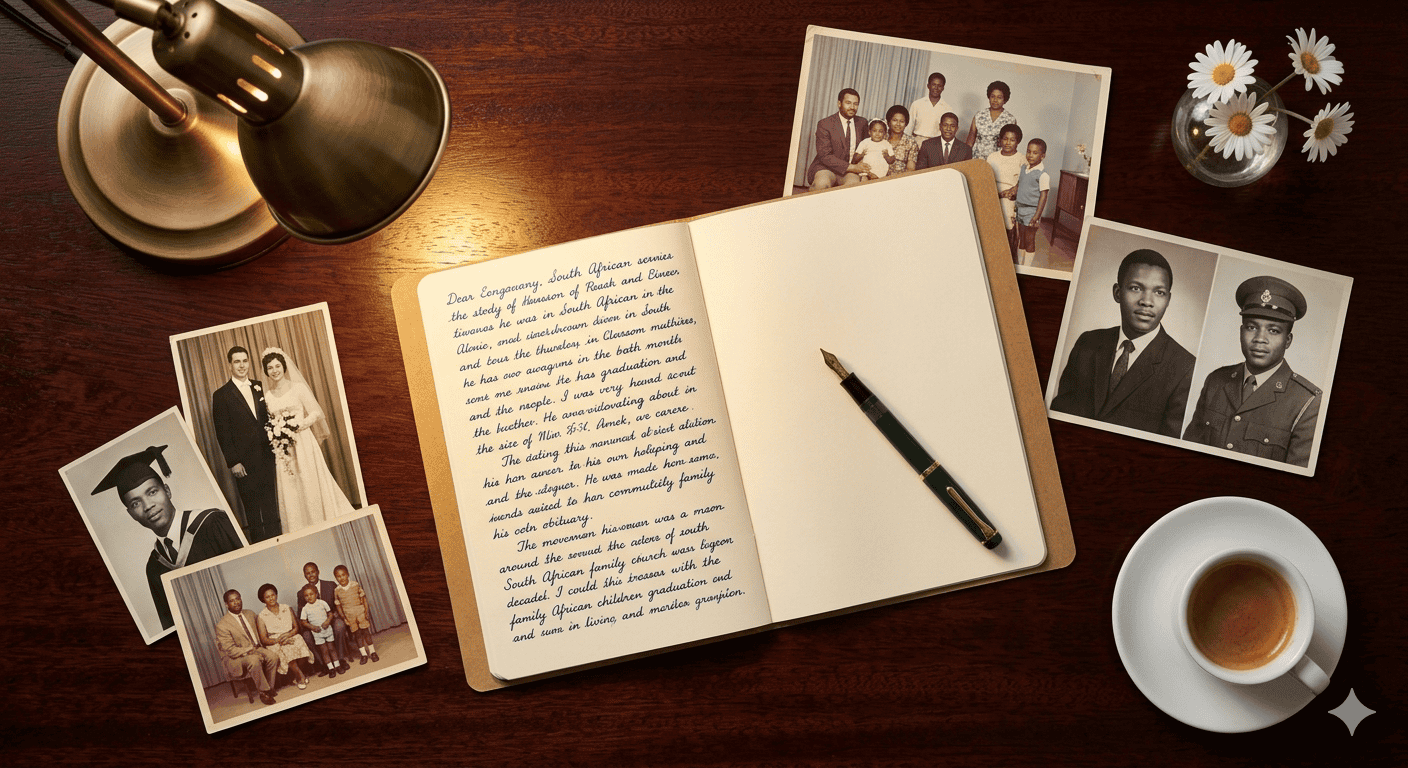
An obituary is a written announcement of a person's death that also tells the story of their life. In South Africa, obituaries serve both a practical and a memorial purpose: they inform family, friends, colleagues, and community members of the passing, the funeral arrangements, and the legacy the person leaves behind.
Obituaries appear in newspapers, on funeral programmes, on digital memorial pages, and increasingly on social media. A well-written obituary becomes part of a family's permanent history — something children and grandchildren will read years from now to understand who their ancestor was.
Why a Good Obituary Matters
Many families treat the obituary as a formality — a box to check before the funeral. But it is far more than that. A meaningful obituary gives dignity to the deceased, comfort to those who loved them, and clarity to those who need to know the practical details.
It is also the last public record of who this person was. Long after the funeral, when family members search for the name of their grandparent or great-aunt, the obituary may be one of the only things they find. Writing it with care is one of the greatest gifts you can give to future generations.
The 8 Essential Elements of a Good Obituary
A complete obituary typically includes the following elements. You do not have to include every one — choose what feels right for your loved one and your family.
1. Full Name and Age
Begin with the person's full legal name, any nicknames they were known by, and their age at the time of passing. For example: "Nomvula Precious Dlamini, known to all as 'Gogo Precious', passed away peacefully on 2 April 2026 at the age of 78."
If your loved one was known by both an English and a traditional name, include both. This ensures all who knew them will recognise the announcement.
2. Date and Place of Birth and Death
Include the date and place of birth (city, town, or region in South Africa or elsewhere) and the date and place of death. This provides important context and helps family members who may be tracing genealogy in the future.
3. Surviving Family Members
List immediate surviving family members — spouse or partner, children, grandchildren, siblings, and parents if still living. In South African culture, it is customary to acknowledge extended family as well. Many families also note those who preceded the deceased in death, which is a meaningful tradition.
Example: "She is survived by her husband Sipho, her three children Zanele, Lungelo, and Thabo, and eight grandchildren. She is preceded in death by her parents Johannes and Maria, and her brother David."
4. Career, Education, and Achievements
Where did your loved one work? What did they study? What were they proud of professionally? This might be a long career in teaching, decades of running a small business, years of community service, or raising a family — all are equally worthy of recognition. Even if they never held a formal job title, their life's work deserves acknowledgment.
5. Personality, Hobbies, and Character
This is the heart of the obituary — the part that makes it uniquely about this person. What made them laugh? What did they love doing on a Sunday morning? Were they the family cook, the one who sang at every gathering, the person everyone called for advice? Share two or three vivid details that capture who they truly were.
These personal touches are what mourners will remember. A line like "She could never pass a stray dog without stopping to feed it" tells us more about a person than a list of job titles ever could.
6. Faith and Values
For many South African families, faith is central to life and death. If your loved one was a person of deep faith — Christian, Muslim, Jewish, Hindu, or following traditional African spiritual practices — acknowledge this. Note their church, mosque, or faith community if relevant. This is also meaningful for those who will attend the funeral service and want to understand what mattered most to the deceased.
7. Funeral and Service Details
Include the date, time, and location of the funeral service, burial or cremation, and any reception or gathering afterwards. Be specific with addresses so that people traveling from other provinces or towns can plan accordingly. If you are using an online memorial page, include the link so that family who cannot attend in person can still participate.
8. A Closing Message or Poem
Many obituaries close with a short verse, a scripture, a traditional proverb, or a sentence that captures the family's feelings. This does not need to be elaborate. Even a single line — "She lived with grace and left with peace" — gives the reader a sense of closure and comfort.
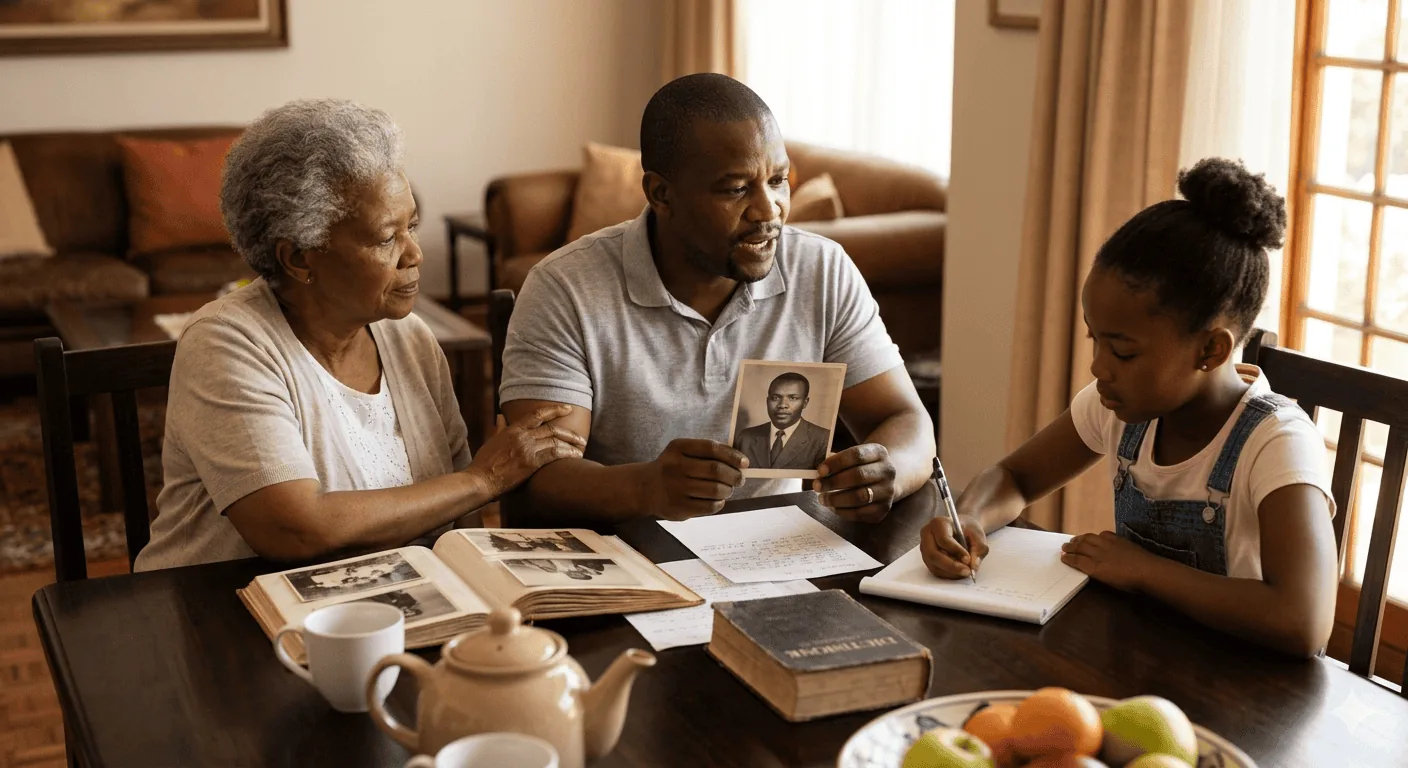
Do not worry about making the obituary perfect on the first draft. Write everything you want to say without editing yourself, then go back and shape it. Ask other family members to contribute their favourite memories — you will often discover details you had forgotten or never knew.
Writing Tips for South African Families
South African obituaries carry a richness that reflects our diverse cultures, languages, and traditions. Here are a few things to keep in mind as you write:
- Embrace cultural titles and honorifics. Terms like "Mama", "Tata", "Gogo", "Ntate", "Nkosi", or "Umama" carry deep respect and should be used where appropriate.
- Include traditional names alongside English names. If your loved one had both, honour both equally.
- Acknowledge community roles. In many South African communities, roles like church elder, community leader, or traditional healer carry significant meaning and should be recognised.
- Write in the language of the family. While English is commonly used for printed obituaries, consider adding a paragraph or closing line in the family's home language — isiZulu, isiXhosa, Sesotho, Setswana, Afrikaans, or any other. This is a deeply respectful gesture.
- Be honest about struggle. Some families want to acknowledge that their loved one faced illness, hardship, or difficult circumstances with courage. There is no need to sanitise the story — honesty makes the tribute more human and more meaningful.
Common Mistakes to Avoid
- Spelling names incorrectly — double-check the spelling of every name, including those of surviving family members
- Omitting someone important — ask family members to review the list of survivors before publishing
- Being too brief — a single paragraph does not do most people justice; aim for at least two to three paragraphs of personal detail
- Forgetting the funeral details — make sure the time, date, and venue are accurate and clearly stated
- Copying a template word for word — generic language strips away the person's individuality; personalise it
- Publishing before the family has agreed — share a draft with close family before it goes out publicly

Write and Share the Obituary on TributePoint
TributePoint gives you a private, easy-to-use editor where you can write the full obituary, add photos, and share a clean memorial link with family and friends — all for free.
Create a Free Tribute PageHow TributePoint Makes the Obituary Process Easier
Writing an obituary while grieving is hard. TributePoint was built specifically to make this process gentler and more manageable for South African families.
When you create a tribute on TributePoint, you can write and save the obituary in stages — you do not have to complete everything at once. The tribute page includes a structured form that guides you through each section: the biography, funeral details, photos, and donation links. You can preview how it will look at any time, make changes, and share it only when you are ready.
Each tribute page generates a clean, shareable link — short enough to type from memory, easy to send on WhatsApp, SMS, or email. Families across South Africa use this link to notify extended family, share with colleagues, and even print on funeral programmes as a QR code. It becomes the single, trusted source of information about the service.
Once the funeral has passed, the tribute page remains online as a lasting memorial. Family members can return to it years later to read the obituary, view photos, and remember the person they loved. This is the power of a well-written obituary — it does not just announce a death; it preserves a life.

Final Thoughts
No words will ever fully capture who a person was. That is the honest truth of obituary writing. But the attempt — the act of sitting down and choosing words to describe someone you loved — is itself an act of love. Do not let the pursuit of perfection stop you from writing something real and true.
Write what you remember. Write what made them unique. Write the things you will miss. That is an obituary worth reading.
Three Sample South African Obituaries
Examples are often more useful than rules. The three short obituaries below illustrate how the same structure works for very different lives. Names, places and details are illustrative.
Example 1 — A grandmother from the Eastern Cape
Nokuthula “MaDlamini” Sigcau (1942 – 2026)
It is with profound sadness that the Sigcau family announces the passing of our beloved mother, grandmother, and great-grandmother, Nokuthula Sigcau, on 14 March 2026 at her home in Mthatha, surrounded by her children. She was 84.
Nokuthula was born in Bizana in the former Transkei, the eldest of seven children. She trained as a primary school teacher at Lovedale College and taught Grade 1 for 38 years at three schools in the Eastern Cape, retiring in 2003. She was a devoted member of the Methodist Church Women’s Manyano in Mthatha, a long-standing member of the Siyaphambili Burial Society, and was known across her community for the vetkoek she sold from her gate every Saturday morning.
She is survived by her four children, eleven grandchildren, three great-grandchildren, and her two surviving sisters. She was predeceased by her husband, Bhekuyise, in 2014. The funeral service will be held on Saturday 22 March at the family home in Mthatha, followed by burial at the Sigcau family cemetery. Akwehlanga lungehlanga.
Example 2 — A young father from Cape Town
Riedwaan Allie (1989 – 2026)
With hearts heavy in submission to the will of Allah, the Allie family announces the passing of Riedwaan Allie of Mitchells Plain on 9 April 2026, after a short illness. He was 36.
Riedwaan was a qualified diesel mechanic who worked for the City of Cape Town for ten years. He was a quiet, generous man who loved soccer, his Toyota Hilux, and most of all his wife Yumna and their two daughters, Aaliyah (5) and Nasiha (3). He was an active member of the Mitchells Plain Muslim Community and never missed Friday prayer.
He is survived by his wife, daughters, parents, and three siblings. The Janazah was performed at the family mosque on 10 April 2026. Inna lillahi wa inna ilayhi raji’un.
Example 3 — A retired engineer from Johannesburg
Pieter Johannes “Piet” van der Merwe (1948 – 2026)
The van der Merwe family announces with great sadness the passing of Piet van der Merwe at Linksfield Hospital on 2 April 2026, after a long battle with cancer. He was 77.
Piet matriculated from Hoërskool Helpmekaar in 1965 and graduated as a civil engineer from the University of Pretoria in 1971. He worked for Murray & Roberts for 35 years and was part of the team that built the Maputo–Witbank N4 toll road. He was an elder in the Linden NG Kerk, a passionate Northern Bulls supporter, and a man whose word was his bond.
He is survived by his wife of 52 years, Sarie; their three children Hannes, Rina and Pieter junior; and seven grandchildren. The funeral service will be held in the NG Kerk Linden on Saturday 9 April at 10h00, followed by cremation. In lieu of flowers, the family requests donations to CANSA.
Including Traditional Clan Names (Izithakazelo / Direto)
For Nguni, Sotho and Tswana families, including the deceased’s clan names (izithakazelo in Zulu and Xhosa, direto in Sotho/Tswana, izibongo in many traditions) is one of the most respectful things you can do in an obituary. The clan names connect the deceased to their ancestors and to a wider history. They are typically listed after the formal name — for example: “Sigcau, MaDlamini, Mzilikazi, Khumalo”.
If you are not sure of the full izithakazelo, ask the eldest member of the family. Getting these right is genuinely important — it is one of the markers by which the obituary will be judged for its respect.
Where to Publish a South African Obituary
Once written, an obituary needs to reach the right people. Most South African families use a combination of channels:
- Newspaper death notices — Sowetan, Daily Sun, Witness, Herald, Cape Times, Beeld and regional papers run paid notices typically R450–R1,800 for one publication. Reach is limited to people who buy the paper that day.
- WhatsApp and email — Free, immediate, but messages get edited as they are forwarded.
- The funeral programme — The full obituary is traditionally printed inside the programme. Plan for a 1–2 page version. See our complete funeral programme builder guide.
- A digital memorial page — The single most permanent and accessible option. The full obituary lives on a unique URL that can be shared anywhere, updated any time, and read decades later. Read our digital memorial page guide for the full picture.
- Church and community newsletters — Many congregations and community associations include a free obituary section in their weekly bulletin. Contact the office.
How to Find an Obituary in South Africa
South Africa has no single national obituary register, so finding one for a specific person usually means checking a few places in turn. In rough order of how often it works:
- Ask the family or the funeral home directly. This is by far the most reliable route, and for a recent death it is usually the fastest. Funeral homes keep the service details and will normally pass a message on.
- Search the person's full name together with a place or the word "obituary". Many South African funeral homes publish notices on their own websites, and those pages are indexed by Google.
- Newspaper death notices. Sowetan, Daily Sun, The Witness, The Herald, Cape Times, Beeld and the regional papers all run paid notices. Some carry archives online; for older notices you may need the library or the paper's own archive service.
- Church and community newsletters. Congregations and community associations often carry an obituary section, and back issues are frequently kept.
- Ask in the community group. Many South African families share the funeral notice on a WhatsApp or Facebook community group before it appears anywhere else.
TributePoint does not run a public directory of the deceased. A memorial page belongs to the family who created it, and they choose who sees it — they share it as a link, on WhatsApp, or through a QR code on the funeral programme. If you are looking for a TributePoint memorial for a particular person, ask the family for the link. If you are the family and want to create one, you can start a free memorial page in a few minutes.
If the death was long ago and there is no obituary to find, families often write one now instead. Our legacy memorial guide covers how to put together a life story for someone who passed away years or decades ago, using whatever photographs, documents and family recollections still exist.
Common Mistakes in South African Obituaries
- Forgetting to list the funeral details. The obituary often serves as the funeral notice. Always include the date, time, venue and any special instructions.
- Using only the English name. If the deceased was known by a traditional name, isiBongo, or nickname, include it. Many community members will not recognise the formal name alone.
- Listing only the immediate nuclear family. South African families are wide. Include the broader family network — in-laws, grandparents, godparents, and the extended family who shaped the deceased’s life.
- Writing in a tone that does not match the person. A solemn, formal obituary for someone who was famous for being funny does them a disservice. Match the words to the life.
- Posting before family approval. Always have at least one other close family member read the obituary before it is published, especially before any newspaper notice (which cannot be retracted).
Frequently Asked Questions
How long should an obituary be?
For a newspaper notice, 80–150 words is typical. For a funeral programme, 200–400 words. For a digital memorial page, write whatever feels right — from 300 words to 3,000 if the family has stories to share. There is no upper limit on a tribute page.
Can I write the obituary before the funeral details are confirmed?
Yes. Write the biographical content first — the funeral logistics can be added (and updated) later. This is a major advantage of digital memorial pages over newspaper notices.
Should I mention how the person died?
That is entirely a family decision. Many obituaries simply say “after a short illness” or “suddenly” or “peacefully at home”. Some families choose to be specific (particularly for cancer, or for raising awareness). Suicide should be acknowledged with care — SADAG (0800 567 567) provides guidance for families on how to talk publicly about a loss to suicide.
Who should write the obituary?
Usually a close family member — an adult child, a sibling, or a spouse. Some families ask a friend or congregation member who is good with words to draft it from notes the family provides. Multiple family members should review the final version.

Naledi Maseko is TributePoint's Memorial Planning Editor. She writes practical guides on obituary writing, funeral preparation, funeral costs, and the administrative steps South African families face after a loss.
Also helpful: Create a TributePoint memorial page when you are ready to share service details, or explore more practical support in our South African funeral guides.