Grief is one of the most universal human experiences, and one of the loneliest. Losing a parent, a child, a partner, a sibling, or a friend leaves a gap that nothing can fully fill. This guide is written for South African families who are walking through that grief — and for those who want to support someone who is. You do not have to carry this alone.
These South African services are free to call and staffed by trained counsellors:
- SADAG (South African Depression and Anxiety Group) — 0800 567 567, or SMS 31393 for a call back.
- Lifeline South Africa — 0861 322 322.

Understanding Grief
Grief is not a single emotion — it is a complex, deeply personal process that looks different for every person. You may feel sadness, numbness, anger, relief, guilt, disorientation, or all of these in the space of a single day. There is no correct way to grieve, and there is no set timeline for when it should end.
The commonly referenced "five stages of grief" — denial, anger, bargaining, depression, acceptance — were originally intended as a description of what some people experience, not a prescription for what everyone must go through. Many people do not move through them in order. Some skip stages entirely. Others revisit the same stage many times. All of this is normal.
What grief research consistently shows is that acknowledging loss, talking about it, and staying connected to community — rather than isolating — leads to better long-term wellbeing. This is why reaching out for support is not a sign of weakness. It is one of the healthiest things you can do.
You Do Not Have to Grieve Alone
South African culture has always understood this instinctively. The concept of ubuntu — "I am because we are" — is rooted in the idea that human beings exist in relation to one another, not in isolation. Grief in South African communities is often a communal experience: people gather, bring food, sit together through the night, and share the weight of loss collectively.
But community support is not always enough. Some losses are so severe, some grief so complicated, that professional guidance is needed. Recognising when to seek that support is an act of self-awareness and courage.
Professional Grief Counselling in South Africa
Grief counselling is available across South Africa through private therapists, non-profit organisations, and public health services. Here are some organisations and avenues to consider:
South African Depression and Anxiety Group (SADAG)
SADAG is South Africa's largest mental health support organisation. They offer a grief and bereavement support line, as well as referrals to counsellors and support groups across the country. Helpline: 0800 567 567 (toll-free, 24 hours). They also operate an SMS helpline: SMS 31393.
Lifeline South Africa
Lifeline provides telephonic counselling and crisis support nationwide. Many Lifeline branches also offer face-to-face grief counselling and support groups. National crisis line: 0861 322 322. Find your nearest branch at lifelinesa.co.za.
Child and Family Welfare Organisations
The Child Welfare South Africa network includes organisations in most provinces that provide grief counselling and bereavement support for children, parents, and families — often at low or no cost. Search for your nearest branch via childwelfaresa.org.za.
Employee Assistance Programmes (EAPs)
Many South African employers offer Employee Assistance Programmes that include confidential grief counselling sessions. If you are employed, contact your HR department to ask whether your company has an EAP and how to access it.
Private Psychologists and Social Workers
A registered psychologist or clinical social worker can provide one-on-one grief therapy. Sessions are available in person and increasingly via video call, which helps families in rural areas or those with limited transport access. Ask your GP for a referral, or search the Health Professions Council of South Africa (HPCSA) register at hpcsa.co.za.

If you have medical aid, grief counselling with a registered psychologist or social worker is often partially or fully covered. Check your plan's mental health benefits or call your medical aid's helpline before your first appointment. If you do not have medical aid, ask about sliding-scale fees — many counsellors adjust their rates based on financial need.
Community and Faith-Based Support
For many South Africans, the first and most natural source of support after a loss is the community of faith they belong to — a church, mosque, synagogue, or Hindu temple. Religious leaders who have walked alongside families in grief can offer comfort, prayer, and practical support in ways that are deeply culturally resonant.
Beyond formal religious structures, many communities have informal support networks — neighbours who bring food, friends who sit with the grieving, stokvels that contribute to funeral costs, and elders who share wisdom from their own experience with loss. Do not underestimate the power of these networks. Accept the help that is offered.
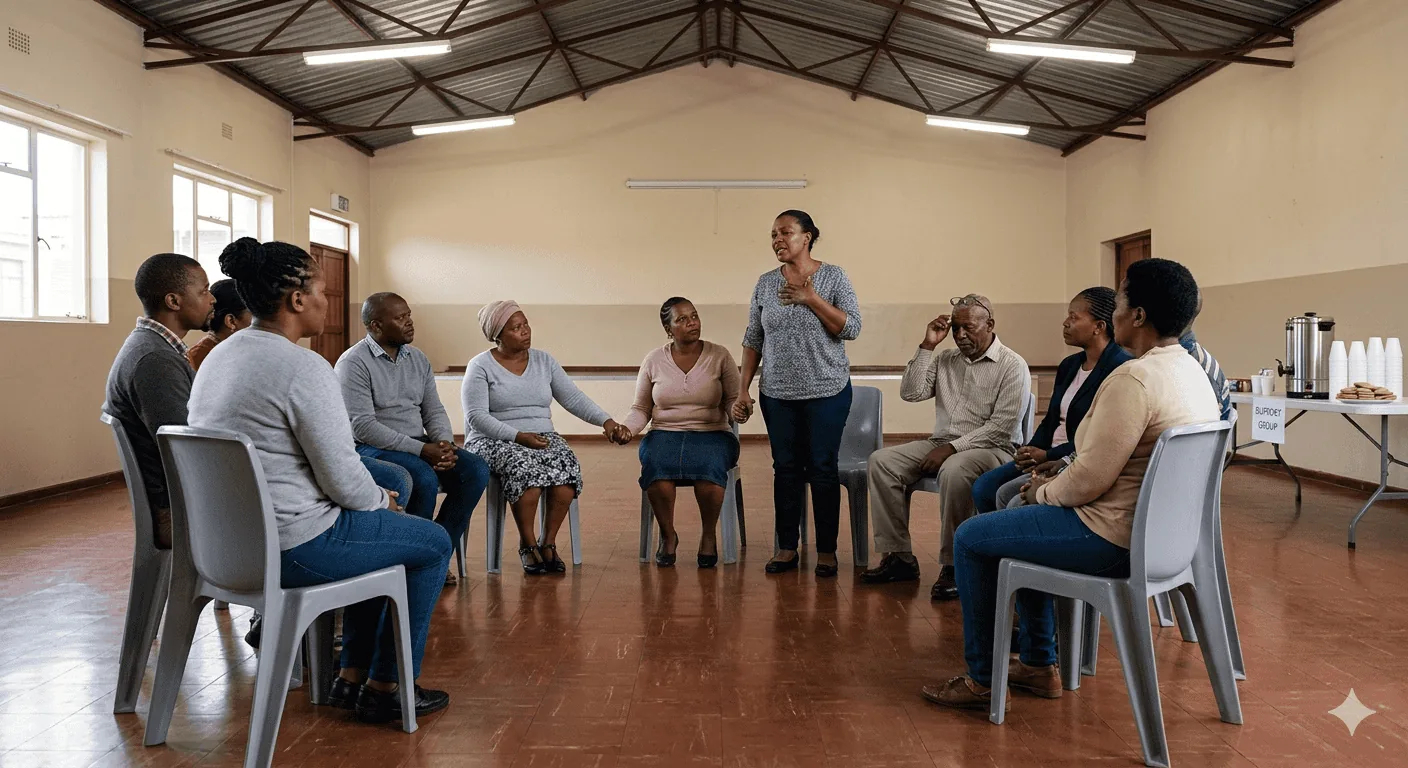
Community support groups for bereaved parents, widows, widowers, and those who have lost a child are also increasingly available in South Africa's urban areas. Ask your local clinic, social worker, or SADAG about groups in your area.
How Memorials Help with Healing
Research in grief therapy consistently shows that meaning-making — the process of finding ways to honour and remember the deceased — is an important part of healthy grief. Creating a memorial is not about holding on; it is about building a bridge between the past and the present, between who was lost and who remains.
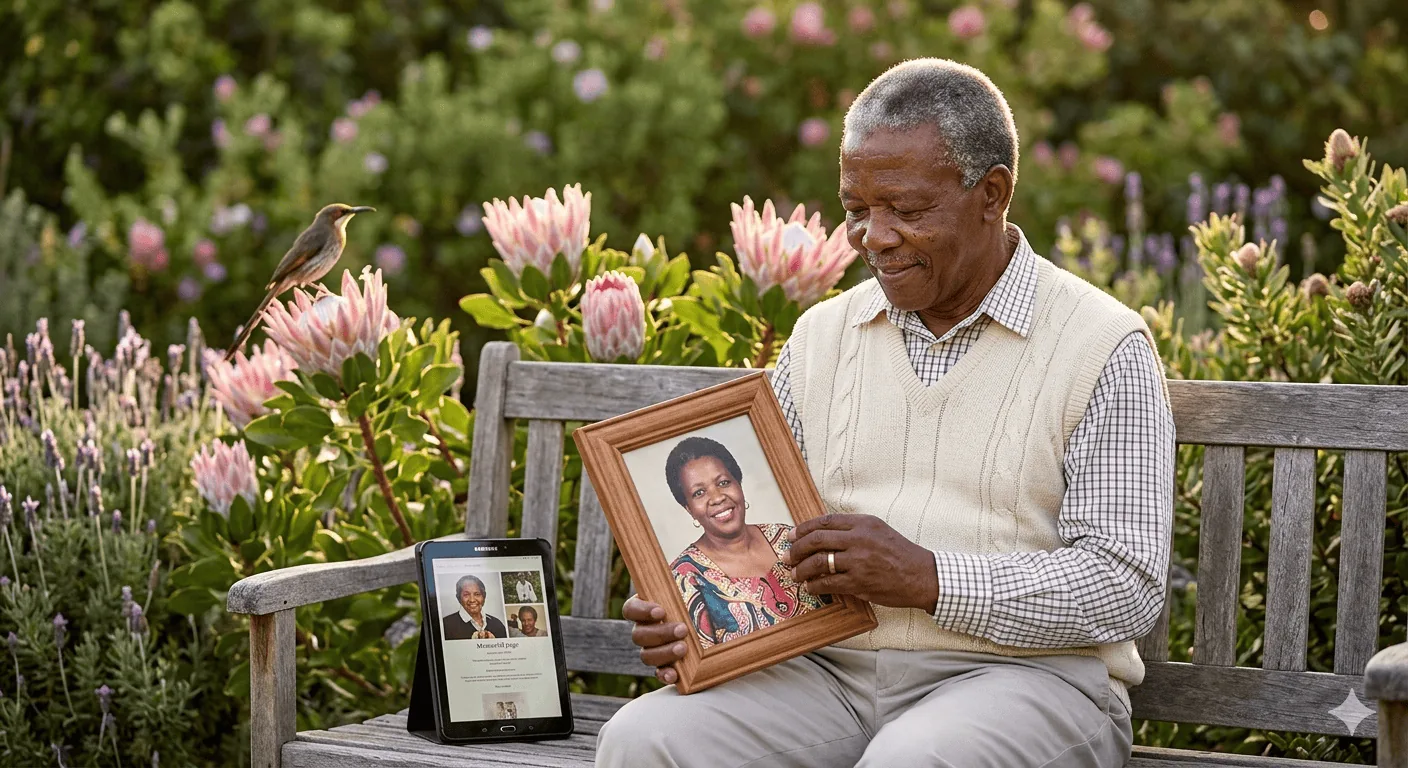
Writing an obituary, curating a photo gallery, and creating a tribute page are acts of love that give form to grief. Many families report that the process of building a memorial — deciding what to include, what stories to tell, which photos to choose — is itself a healing experience. It gives family members something purposeful to do during the most helpless time of their lives.
A permanent digital memorial also means that the person who was lost has a place to exist in memory. Family members can visit the page on anniversaries, birthdays, and difficult days to feel connected to the person they loved. Children can return to it when they are older and want to understand the grandparent they lost when they were too young to know them.
Honour Your Loved One with a Free Tribute Page
Creating a memorial is a powerful act of healing. TributePoint helps South African families build beautiful, lasting tribute pages — free, dignified, and permanent.
Create a Free TributeSupporting a Grieving Friend or Family Member
Knowing what to say — or what not to say — to someone who is grieving is one of the most common concerns people have. The truth is, there is rarely a perfect thing to say. What matters far more is showing up.
- Be present without needing to fix anything. You cannot fix grief. Sitting with someone in their pain, without trying to explain it away or rush them through it, is one of the most valuable things you can offer.
- Say the person's name. Many grieving people fear that the world will forget the one they lost. Mentioning the deceased by name — "I've been thinking about how much your mother loved cooking" — is a gift.
- Offer specific help. "Let me know if you need anything" is well-intentioned but hard to act on when someone is grieving. "I'm bringing dinner on Thursday — is 6pm okay?" is far more helpful.
- Check in weeks and months later. The first days after a loss are usually filled with people and activity. The silence that falls six weeks later, when everyone has returned to normal life and the grieving person has not, is often the loneliest time. A text or a call then means more than you know.
- Avoid minimising language. Phrases like "they're in a better place," "at least they didn't suffer long," or "you need to be strong" are rarely as comforting as they are intended to be. Simply saying "I'm so sorry" and "I love you" is enough.

When to Seek Professional Help
Most grief does not require professional intervention — human beings are remarkably resilient, and community support goes a long way. However, there are signs that suggest professional guidance would be beneficial:
- Grief that significantly interferes with daily functioning for more than a few weeks (unable to eat, sleep, work, or care for children)
- Thoughts of suicide or self-harm — call SADAG immediately on 0800 567 567
- Complicated grief: feeling unable to accept the death even months later, or experiencing intense, prolonged symptoms that do not ease over time
- Grief combined with substance use (increased alcohol or drug use as a coping mechanism)
- Children who are struggling significantly — children grieve differently from adults and may benefit from specialised support
Seeking help is not giving up on the person you lost. It is taking care of yourself so that you can continue to carry their memory with love, rather than be crushed by the weight of it.
Free and Low-Cost Grief Support Across South Africa
Cost should never be the reason a grieving South African does not get help. Many of the country’s best grief support services are free, including some you may not know exist.
- SADAG (South African Depression and Anxiety Group) — Free national counselling line, 7 days a week: 0800 567 567. SMS line for confidential help: 31393. SADAG also runs free online support groups via Zoom for bereaved adults and bereaved parents.
- Lifeline South Africa — Free crisis counselling: 0861 322 322. Branches in Johannesburg, Cape Town, Durban, Port Elizabeth, Pretoria and East London offer face-to-face counselling on a sliding scale (often R0–R150 per session).
- Hospice Palliative Care Association — Bereavement programmes are offered free of charge by most hospice organisations across South Africa, even if your loved one was not under hospice care. Find your nearest branch via the HPCA directory.
- FAMSA (Family and Marriage Society of South Africa) — Sliding-scale individual and family bereavement counselling. Useful when grief is straining a relationship or affecting children.
- Compassionate Friends South Africa — Peer support specifically for parents who have lost a child, including stillbirth and infant loss. Local groups in major centres.
- Your employer’s EAP (Employee Assistance Programme) — Most medium and large South African employers offer 4–6 free counselling sessions per year through providers like ICAS, Careways, or Workforce Healthcare. These are 100% confidential and your employer cannot see who used the service.
- Your medical aid — Discovery, Bonitas, Momentum and most other schemes pay for psychologist sessions from your day-to-day benefits or savings account. Ask your scheme for a list of in-network providers in your area.
Cultural and Religious Mourning in South Africa
Western counselling models are valuable but they are not the whole story. South African grief is shaped by cultural and religious mourning customs that have carried families through loss for generations. These customs are not in opposition to professional support — the most resilient families combine both.
African traditional mourning
In Zulu, Xhosa, Sotho, Tswana, Pedi and Venda traditions, the mourning period is usually marked by the bereaved family wearing dark clothing for a prescribed time (often six months for a spouse, less for other relatives). The home is darkened during the early mourning period, and certain activities — entertainment, celebrations, marriage — are paused. The family is brought formally out of mourning by an elder or a ritual washing ceremony. These structured stages give grief a recognisable shape and a clear endpoint, which can be deeply healing. See our guide on Zulu funeral traditions for the full sequence including ukubuyisa.
Christian mourning
For Christian families, the church often plays a central role in early grief: prayer leagues conduct nightly umkhuleko, the pastor visits the home, and the funeral itself emphasises hope of resurrection. Many congregations run grief support groups (GriefShare is one widely used programme available across denominations). Counsel from a respected pastor combined with attendance at a structured grief group is often the right combination.
Muslim mourning
In Islamic tradition, the bereaved family observes a formal mourning period of three days, with intense community visitation and condolences. A widow observes iddah (a four-month and ten-day period). Quranic recitations are held in the home, and meals are brought by extended family and the community. Muslim Judicial Council and the Jamiatul Ulama provide pastoral care and counselling.
Hindu mourning
Hindu families typically observe a 13-day mourning period (antyesti), with daily prayers led by a pandit. The home does not host celebrations during this time. On the 13th day, a ceremony marks the formal end of mourning. Annual remembrance (shraadh) is performed on the anniversary.
Jewish mourning
The seven-day shiva is followed by sheloshim (30 days) and, for a parent, an extended 11-month period during which mourners say Kaddish daily. The structured stages of Jewish mourning are widely studied as a model of healthy grief processing.
Real Things That Help in the First 90 Days
From working with hundreds of bereaved South African families, certain practical actions consistently help — not because they remove grief, but because they give you something to hold onto when everything feels unmoored.
- Eat one proper meal a day, even if you do not want to. Grief disrupts appetite, sleep and concentration. Skipping meals deepens the fog. A simple bowl of pap and morogo, or rice and beans, is enough.
- Walk for 20 minutes outside, every day. Sunlight, movement and fresh air do measurable things to the grieving brain. It is not optional self-care; it is medical.
- Limit alcohol in the first three months. Alcohol numbs the early pain but extends the grief by months or years. South African bereavement counsellors see this pattern almost universally.
- Talk about the person, by name. Many South African families avoid speaking the deceased’s name out of respect or pain. Research consistently shows that families who actively remember and name their dead grieve in healthier patterns.
- Keep a ritual. Lighting a candle every Sunday evening, visiting the grave on the same day each month, looking at the memorial page on the anniversary of small life events — rituals give grief a shape it can settle into.
- Let the community help. South African culture is built on ubuntu. When the church group offers to bring food, accept it. When the burial society sends women to clean the house, let them. Refusing help is not strength.
How a Memorial Page Supports Grief
Many bereaved families return to their loved one’s memorial page far more often than they expected. Looking at the photos, reading the obituary, lighting a virtual candle, leaving a condolence message in the early hours of a difficult morning — these small acts give grief somewhere to go. Read more about how virtual candles and condolence messages create ongoing connection, and how families can use a tribute page to keep memories alive long after the funeral.
Frequently Asked Questions
How long does grief usually last?
There is no fixed timeline. The acute, daily-disabling phase of grief usually eases over 6–18 months, though waves of sadness can return for years — particularly on anniversaries, birthdays, holidays and family milestones. If symptoms are not easing at all after a year, that is a good time to seek professional support.
How do I support a friend who is grieving without saying the wrong thing?
Show up. Bring food. Sit quietly. Use the deceased’s name. Ask how the person is sleeping, eating, coping — not just whether they are “okay”. Avoid platitudes like “they are in a better place” or “everything happens for a reason”. Most grieving people remember the people who showed up far more than the people who said anything in particular.
Is it okay if I am not crying?
Yes. Grief looks different for every person. Some people cry constantly; others feel numb for weeks before tears come; some people feel anger or restlessness more than sadness. There is no “correct” way to grieve.
Where can children get bereavement support in South Africa?
Hospice bereavement programmes, school counsellors, and dedicated services like the Sunflower Fund (for children who have lost a parent to cancer) all offer child-specific support. SADAG (0800 567 567) can refer you to child grief specialists in your area.

Ayesha Daniels is a Family Support Writer at TributePoint. She covers grief, remembrance, and the ways families can stay connected and supported before, during, and after a funeral.
Also helpful: Create a TributePoint memorial page when you are ready to share service details, or explore more practical support in our South African funeral guides.