Coffins in South Africa start at around R1,500 for a chipboard flatpack and run past R45,000 for a premium imported casket. This guide sets out the price bands by material, explains what actually drives the cost, and lists the questions worth asking before you buy — including the ones funeral homes do not volunteer.
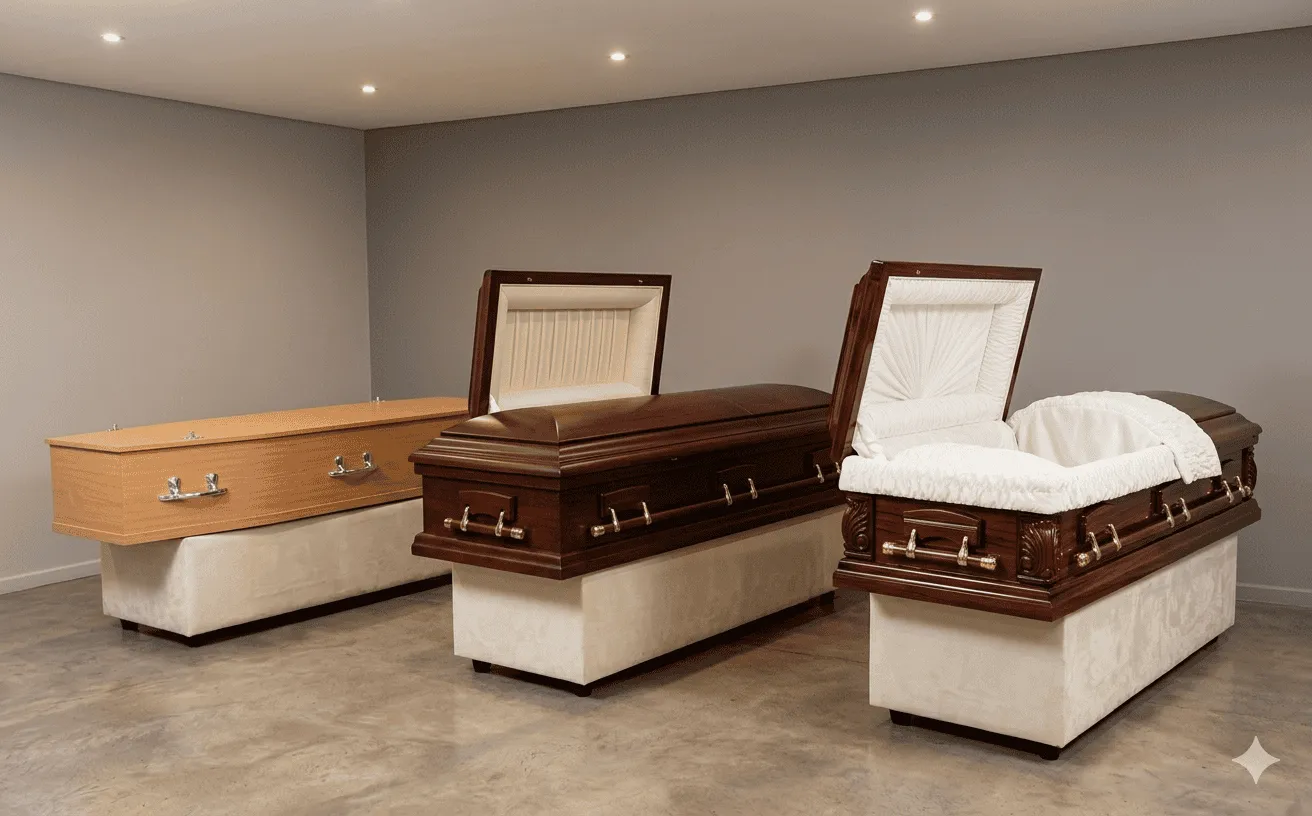
The short answer: coffins in South Africa start at around R1,500 for a chipboard flatpack and run past R45,000 for an imported hardwood or metal casket. Most families end up somewhere between R3,000 and R10,000. Below is what sits behind those numbers — the materials, what actually drives the price, and the questions worth asking before you sign.
These ranges come from the same 2026 pricing behind our South African funeral cost breakdown, gathered from funeral homes across Gauteng, KwaZulu-Natal, the Western Cape and Limpopo. Treat them as a planning guide, not a quote — showroom prices vary enormously between providers in the same city.
Coffin or casket: what is the difference?
The two words are used interchangeably in South Africa, but they describe different shapes:
- A coffin is tapered — narrow at the head and feet, wider at the shoulders — and has a lid that lifts off in one piece. This is the traditional shape and the more common one here.
- A casket is rectangular, usually deeper, and typically has a hinged split lid so the upper half can be opened for a viewing.
Caskets generally cost more than coffins of the same material, partly because they use more timber and partly because they are associated with the premium end of the range. If a funeral home quotes you for a "casket", it is worth confirming whether you are paying for the shape or simply for the word.
Coffin and casket prices in South Africa
| Type | Typical price | What you get |
|---|---|---|
| Chipboard / flatpack coffin | R1,500 – R4,000 | Compressed board with a veneer or fabric covering. Functional, dignified, and used in the majority of South African funerals. |
| Solid wood coffin (pine, meranti) | R5,000 – R10,000 | Real timber with a satin lining and standard hardware. A solid pine coffin with a satin lining typically sits at R6,000 – R10,000. |
| Solid wood coffin (oak, higher-grade finishes) | R10,000 – R25,000 | Better timber, better finish, heavier hardware. |
| Premium and designer caskets | R15,000 – R45,000+ | Mahogany, imported hardwoods and metal caskets, generally sold through larger funeral homes. |
| Cremation coffin | R1,500 – R4,000 | A chipboard or flatpack coffin — the standard choice, since the coffin is consumed in the cremation. |
There is no legal requirement in South Africa to buy an expensive coffin. A body may be buried or cremated in any suitable container. The showroom coffin you are shown first is a commercial choice, not a legal one — and you are entitled to ask what else is available.
What actually drives the price
Material
This is the single biggest factor. Chipboard costs a fraction of solid timber; imported hardwood and metal cost several times more again. The visible difference at a distance, once the coffin is dressed and draped, is often much smaller than the price difference.
Finish and hardware
Handles, hinges, corner fittings, the lining fabric and the quality of the lacquer can move a solid wood coffin several thousand rand up or down. Two coffins made from the same pine can differ by R4,000 on fittings alone.
Size
Oversize and extra-length coffins are made to order and carry a premium. If this applies, raise it early — it also affects lead time, which matters when a funeral date is already fixed.
Where you buy it
Funeral home showrooms carry a mark-up. Independent coffin suppliers — including manufacturers who sell direct — are commonly 30% to 50% cheaper for the same product. You are not obliged to buy the coffin from the funeral home conducting the service, though some charge a handling fee if you supply your own. Ask about that fee before you buy elsewhere, so you can compare the real totals.
Whether it is for burial or cremation
A coffin for cremation is consumed in the process. Spending heavily on one is a decision some families make for the sake of the viewing, and that is entirely legitimate — but it should be a conscious choice. Some funeral homes offer a rental casket: a good casket for the service, with a simple inner container that goes to the crematorium. See our cremation costs guide for how that fits into the wider bill.
Give the service one link to share
A free TributePoint memorial page holds the obituary, the funeral details, the photo tribute and the livestream — so you can share everything on WhatsApp instead of printing for a crowd you cannot count yet.
Create a Free Memorial PageChoosing without pressure
Coffin selection is one of the hardest purchases a family will ever make, and it happens at the worst possible moment. Showrooms are usually arranged so that the mid and upper range is at eye level and the entry-level options are at the end. That is not sinister — it is retail — but it is worth knowing, because grief makes price feel like a measure of love.
It is not. A chipboard coffin at a funeral where the community cooked, the church was full and the programme was read properly is not a lesser farewell than a mahogany casket at an empty service. If someone in the family can attend the arrangement meeting who is not the closest bereaved person, that alone tends to produce better decisions.
Questions to ask before you buy
- What is the full price of this coffin, including VAT and any handling or delivery charge?
- What material is it actually made of — solid timber, veneer, or board?
- Is the coffin included in the funeral package price, or charged on top?
- May we supply our own coffin, and is there a handling fee if we do?
- What is the cheapest option you carry, and may we see it?
- Is this coffin suitable for cremation, if that is what we are arranging?
- What is the lead time, and does an oversize coffin change it?
- Can we have this quote in writing, itemised?
The Consumer Protection Act entitles you to an itemised price list from any funeral home before you sign a contract. A funeral home may not refuse to release a body over an unpaid bill — that is unlawful. And you may cancel a funeral service agreement within five business days if you change your mind about the provider.
Ways to reduce the cost
- Compare at least three suppliers. Prices for an identical coffin vary widely between providers in the same city.
- Ask to see the full range, not the display selection. Entry-level stock is rarely the first thing you are shown.
- Consider buying independently — after confirming any handling fee the funeral home charges.
- Match the coffin to the plan. If the service is a cremation, the coffin does not need to be an heirloom.
- Decide the budget before you walk into the showroom, ideally with someone alongside you who is a step further back from the loss.
- Spend the difference where it lasts. A tombstone, or a permanent memorial page, outlives the day itself.
Where the coffin fits in the total funeral bill
For most South African families the coffin is one of the two or three largest lines on the invoice, alongside catering and the burial plot. It is not, however, the whole picture — body care, transport, grave digging, programmes, flowers, a marquee and the after-tears meal all add up, and a tombstone usually follows months later.
Our full South African funeral cost breakdown puts every line side by side, with realistic totals for both a modest and a full-service funeral. If you are still deciding between burial and cremation, the burial vs cremation comparison covers the cultural and religious side of that choice as well as the money.
Frequently Asked Questions
How much does a coffin cost in South Africa?
Coffin prices in South Africa start at about R1,500 for a chipboard or flatpack coffin. Solid wood coffins generally run R5,000 to R25,000 depending on the timber and finish, and premium or imported caskets range from R15,000 to R45,000 and above. Most families spend between R3,000 and R10,000.
How much is a casket in South Africa?
Caskets — the rectangular, usually hinged-lid style — sit at the higher end of the market. Premium and designer caskets in mahogany, imported hardwood or metal typically cost R15,000 to R45,000 or more. A casket generally costs more than a coffin of the same material.
What is the difference between a coffin and a casket?
A coffin is tapered, narrower at the head and feet and wider at the shoulders, with a lid that lifts off in one piece. A casket is rectangular, usually deeper, and typically has a hinged split lid so the upper half can be opened for a viewing. Caskets generally cost more.
What is the cheapest coffin available in South Africa?
A chipboard or flatpack coffin, from around R1,500. These are made from compressed board with a veneer or fabric covering and are used in the majority of South African funerals. There is no legal requirement to buy anything more expensive.
Can I buy a coffin somewhere other than the funeral home?
Yes. You are not obliged to buy the coffin from the funeral home conducting the service, and independent suppliers are commonly 30% to 50% cheaper for the same product. Some funeral homes charge a handling fee for a coffin they did not supply, so ask about that first and compare the real totals.
Do you need an expensive coffin for a cremation?
No. A coffin is required, but it is consumed in the cremation, so most South African cremations use a chipboard or flatpack coffin at R1,500 to R4,000. If appearance at the service matters, ask whether the funeral home offers a rental casket with a simple inner container for the cremation itself.