On the day a family loses someone, a funeral director is usually dealing with three things at once: paperwork, relatives calling from different places, and a service that must come together fast. This guide looks at the funeral-home side of TributePoint through that real pressure — how teams share updates, keep details accurate, and help families communicate clearly without turning the process into more stress.
Why Funeral Homes Choose TributePoint
Consider a common South African scenario: a family loses a parent on Tuesday morning, relatives are travelling from Mpumalanga and the Eastern Cape, the church needs confirmed service details, and someone abroad is already asking for a livestream link. In those first 48 hours, the funeral home becomes the point of calm. The platform matters only if it helps the team give families that calm.
South Africa has thousands of funeral homes, from one-person operations in rural towns to large chains in Johannesburg and Cape Town. In practice, the same pressure points come up again and again:
- A way for multiple staff to create and manage tributes
- Consistent branding on every page they produce
- Advertising tools to reach families when they need funeral services
- Live streaming as a service offering (not just a family feature)
- Scalable pricing that grows with the business
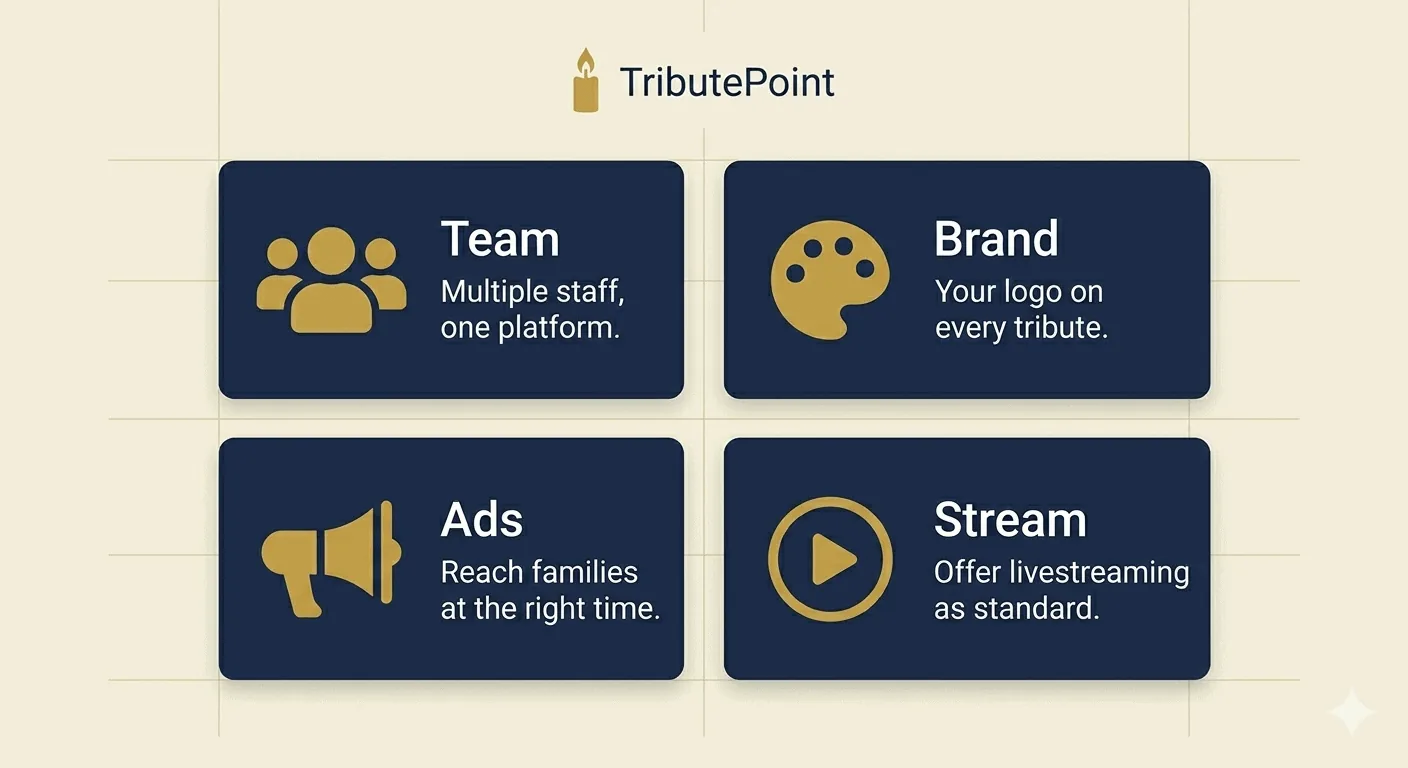
TributePoint works best when it reduces back-and-forth for the family: one place for obituary details, livestream access, tribute sharing, and internal staff coordination instead of five separate tools and conflicting WhatsApp messages.
A 48-Hour Funeral Timeline
Hour 1–6: The funeral home gathers the family’s first confirmed details — the full name, key contacts, likely service date, and whether burial or cremation is being considered. A staff member creates the tribute draft immediately so there is one accurate place to update as decisions are made.
Hour 6–18: One team member handles the family, another confirms venue and clergy, and another begins collecting the obituary, portrait, and programme details. Because the page can stay private at first, the family can review everything before it is widely shared.
Hour 18–30: The funeral director shares the page with close relatives, adds a livestream plan if family is overseas, and prepares a clean link or QR code for WhatsApp and the printed programme. Instead of sending revised posters all night, the team updates one live page.
Hour 30–48: The details are finalised, condolences start coming in, and staff can focus on the service itself. Families are not forced to repeat the same information to every caller because the memorial page already carries the obituary, venue, time, and any donation or livestream information in one place.
Team Management
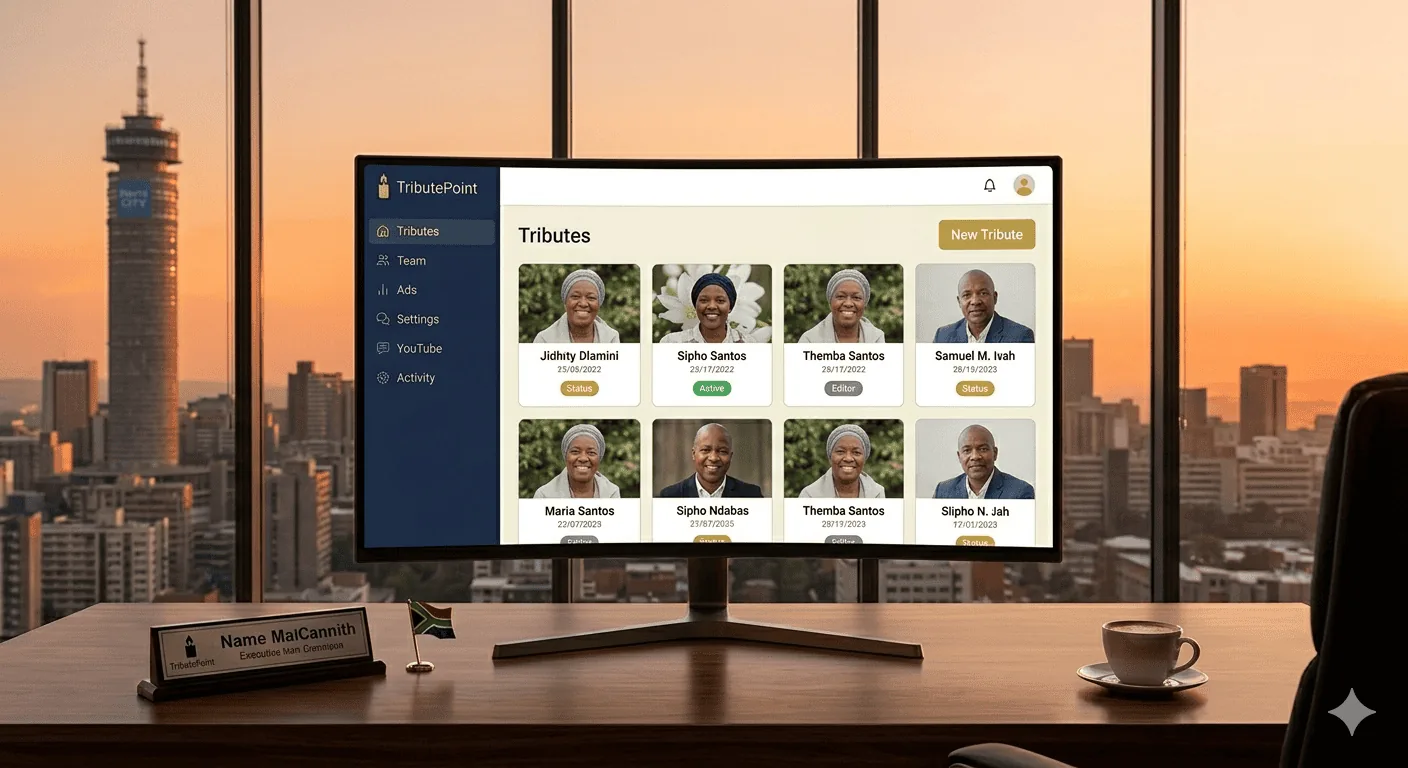
When a funeral is being arranged quickly, the biggest risk is confusion inside the funeral home itself. One person updates the time, another uploads the photo, and a third calls the family with an older version. Team roles matter because they help staff move quickly without publishing the wrong information.
TributePoint uses a three-tier permission system:
Owner
Full control: billing, team, settings, all tributes, and company branding.
Admin
Manage tributes and team members. Cannot change billing or company settings.
Editor
Create and edit tributes. Cannot manage team or access company settings.
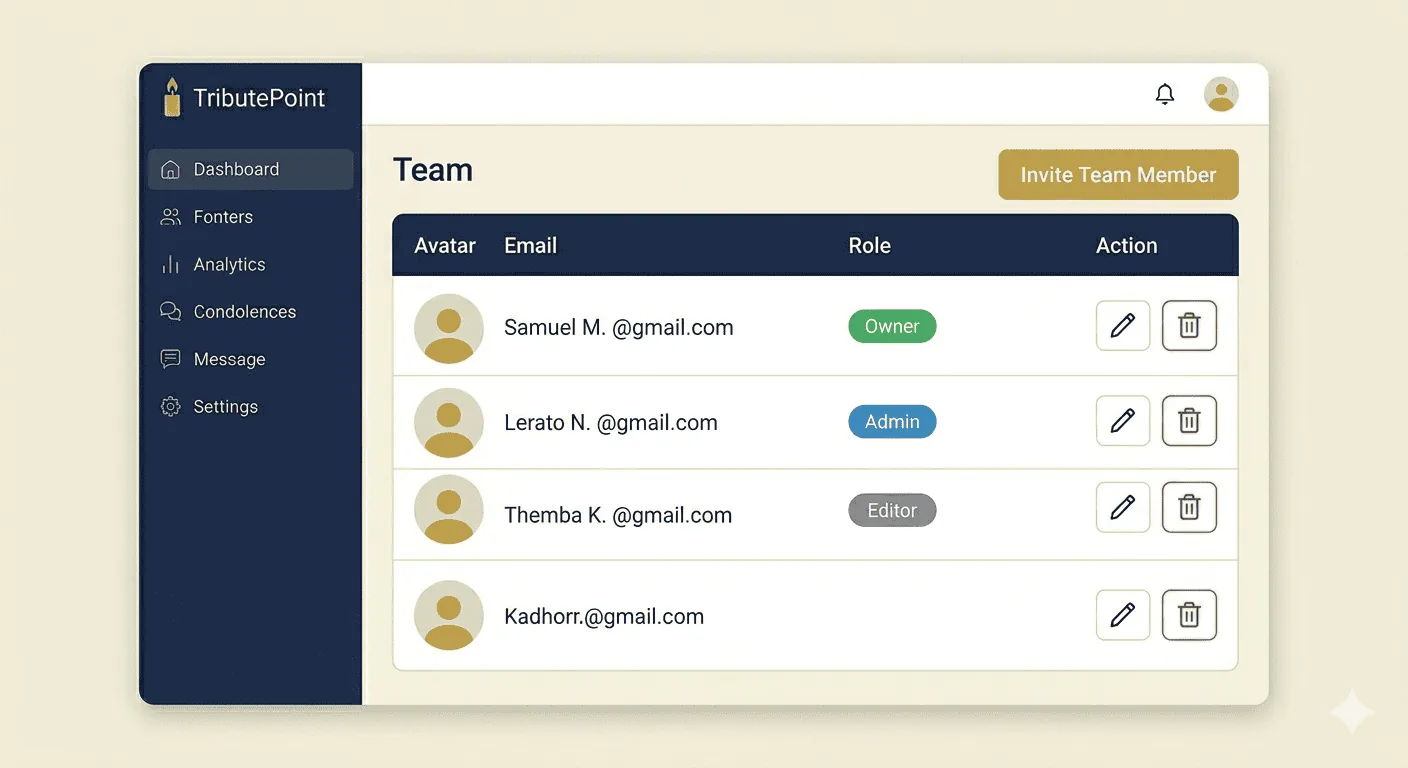
Roles can be changed at any time, and members can be removed with a single click. The dashboard also shows which team member created or updated a tribute, which is useful when a family says, “Who changed the venue?” or “Who uploaded the wrong portrait?” Accountability here protects the family experience, not just the business.
Company Branding
For families, branding is not about marketing language. It is about trust. If the funeral home’s logo, colours, and contact details appear consistently on the memorial page, families know they are looking at the official page rather than an outdated poster or a link forwarded without context.
TributePoint lets you customise every tribute your team creates:
- Logo — upload your company logo once, and it appears on every tribute and memorial page
- Brand colours — set primary and accent colours that override theme defaults
- Custom CSS — for pixel-perfect control, inject your own stylesheet
- Custom themes — upload or request a dedicated theme for your funeral home
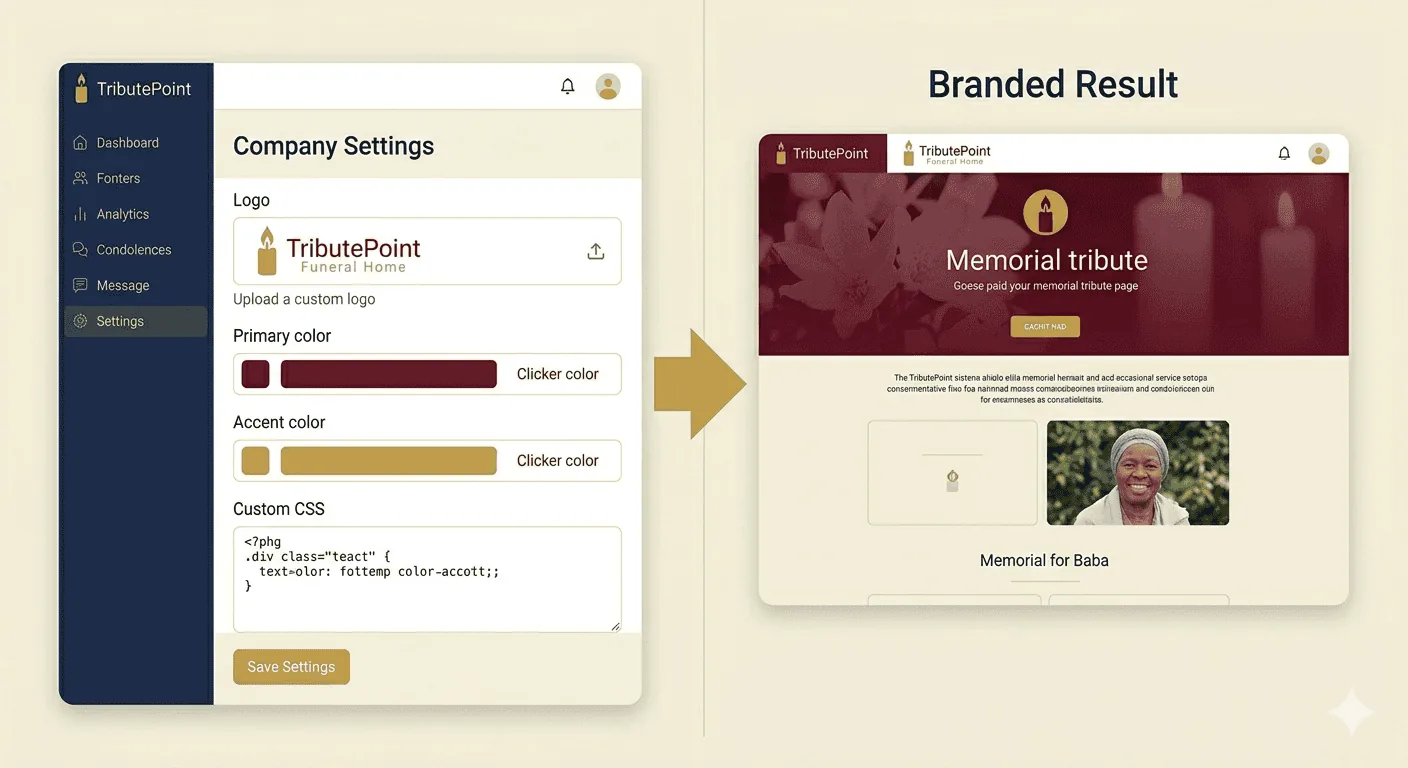
Keep branding quiet and useful. A clear logo, recognisable colours, and correct contact details help families know they are sharing the right page. Heavy promotional language does the opposite during a time of grief.
Advertising & Campaign Management
Advertising needs careful handling in funeral work. The useful question is not, “Can we run an ad?” but, “Will this help a family without making the memorial feel commercial?” For that reason, any campaign use should stay restrained and service-led — for example, pointing families to pricing, aftercare, or livestream booking information when they are actively looking for it.
Creating an Ad
- Navigate to Company → Ads in the dashboard
- Click “New Ad” and upload an image
- Set the destination URL (your website, contact page, etc.)
- Choose placement and targeting options
- Publish or schedule the ad
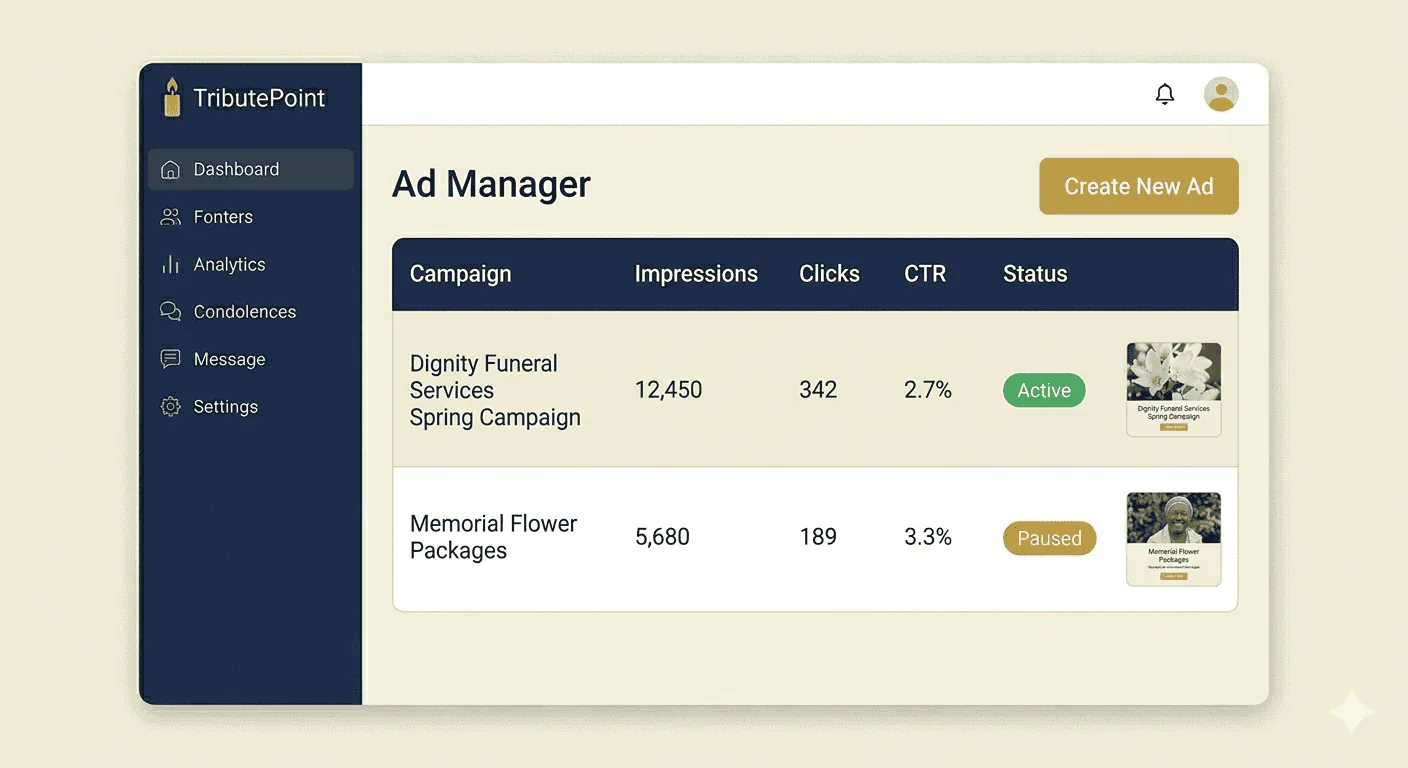
Analytics
Every ad tracks impressions, clicks, and click-through rate (CTR). More importantly, campaigns can be paused or removed immediately if they feel out of place.
Ads can be excluded from specific tributes — and in many cases that will be the right decision. If a family wants a quieter page with no promotional material, the funeral home should be able to honour that without argument.
YouTube Streaming Integration
Streaming matters most when the family cannot all be in one place. A son working in Dubai, an aunt in Cape Town, and a cousin waiting for a visa all need a simple way to witness the service. For the funeral home, the value of YouTube integration is that it reduces last-minute scrambling and gives the family one reliable viewing link.
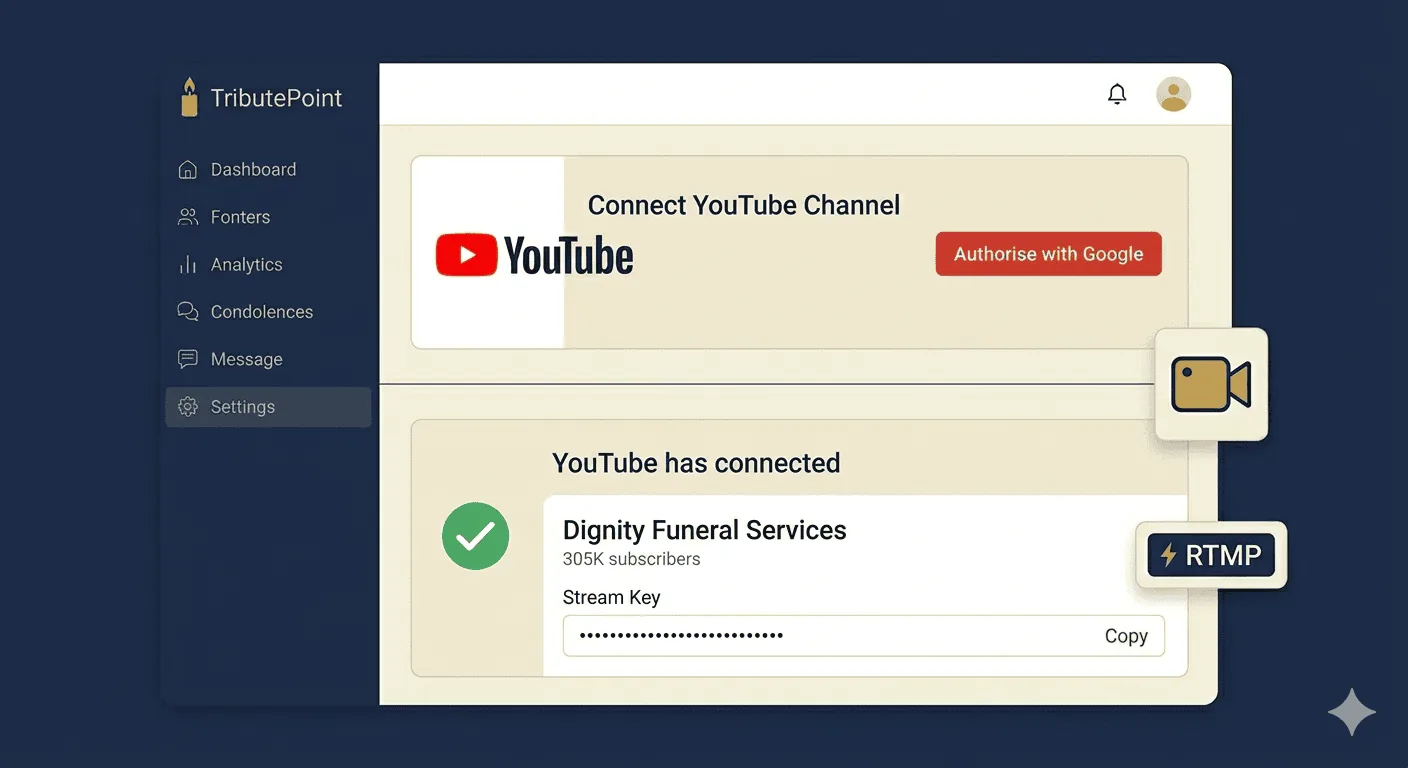
Connect your funeral home’s YouTube channel once, and TributePoint handles the rest:
- OAuth connection — securely link your channel without sharing passwords
- Auto-broadcast creation — TributePoint creates the YouTube broadcast and stream object
- RTMP credentials — stream key and server URL displayed in the dashboard
- Go live from any device — use the built-in browser broadcaster or an RTMP app
Used well, livestreaming is not a gimmick. It is a practical service for families whose support networks are spread across provinces and countries, especially when time and travel costs make attendance impossible.
Activity & Audit Log
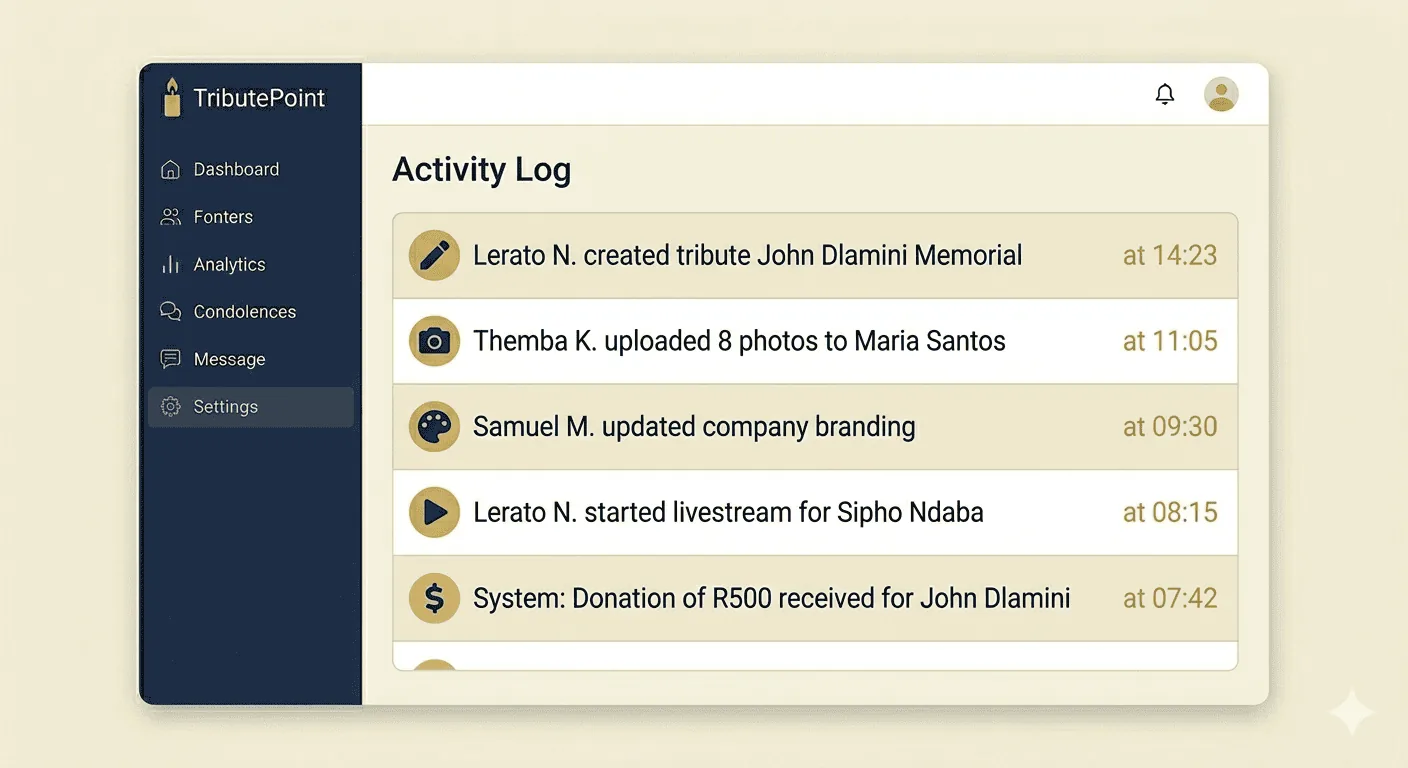
Every action taken by team members is logged: tributes created, photos uploaded, settings changed, livestreams started. The activity log provides full accountability and makes it easy to troubleshoot if something goes wrong.
Subscription Plans
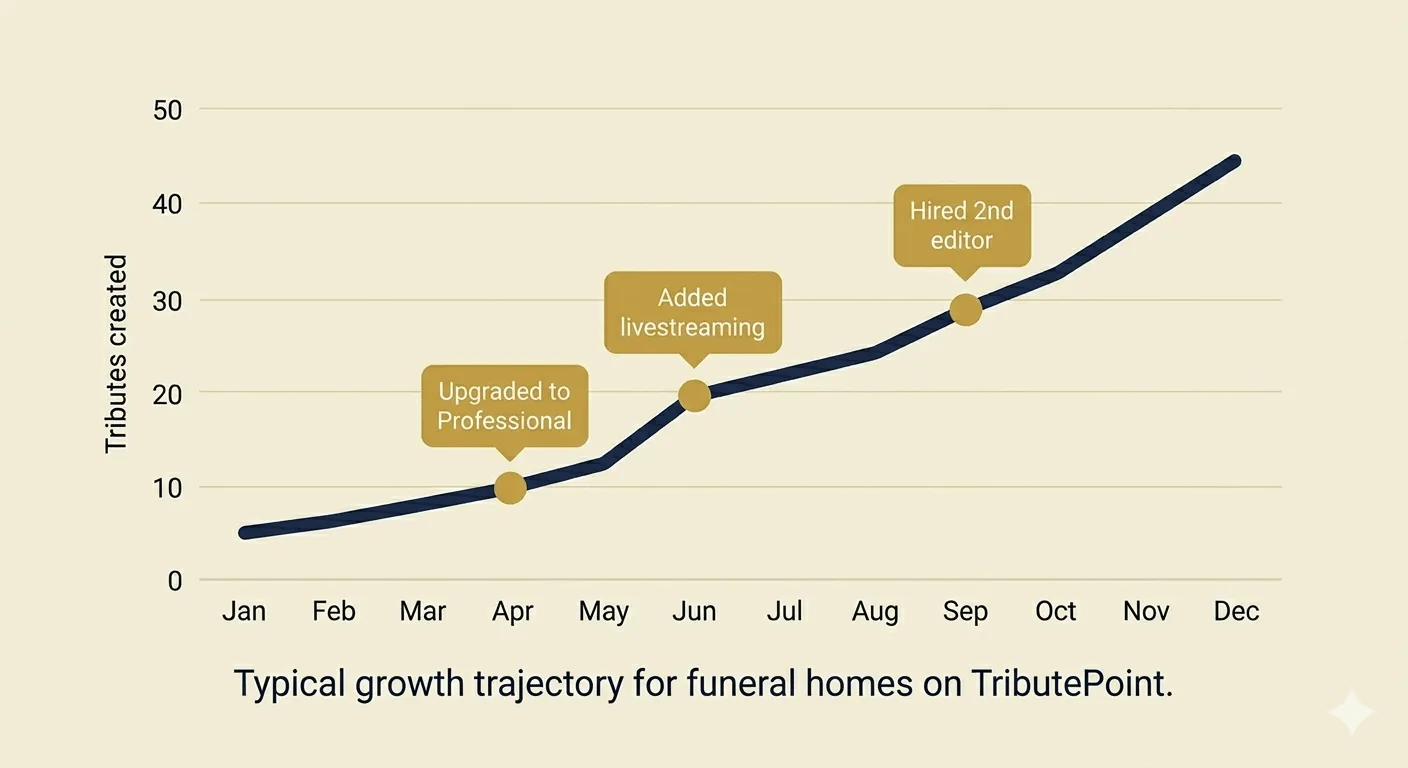
The right plan depends less on company size than on workflow. A smaller parlour handling a few funerals a month may only need a shared dashboard and clear memorial pages. A larger team offering livestreaming, branded pages, and more staff access will need more control.
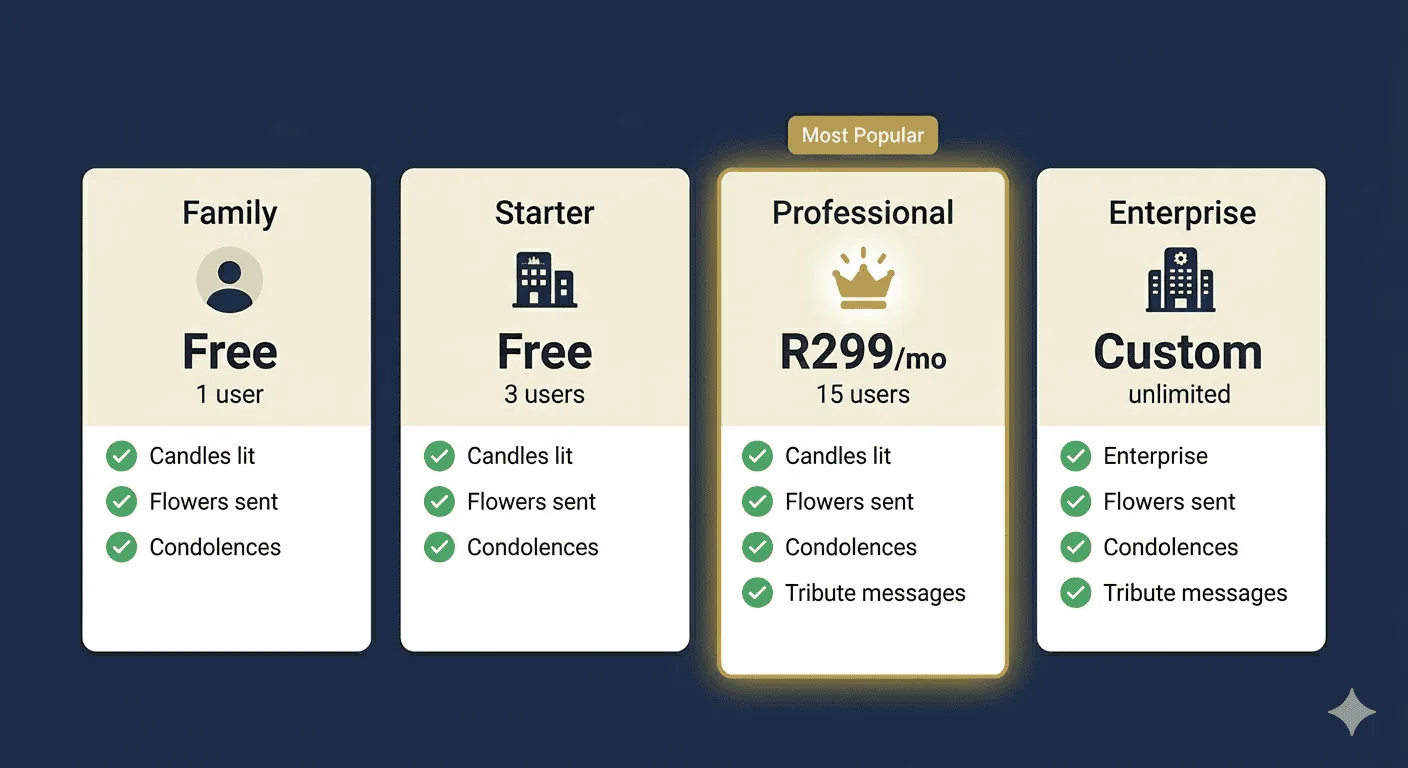
| Plan | Price | Team | Tributes | Key Features |
|---|---|---|---|---|
| Family | Free | 1 | Unlimited personal | All core features |
| Starter | Free | 3 | 25 | Company dashboard |
| Professional | R299/mo | 15 | 500 | Branding, ad-free, custom themes, self-streaming |
| Enterprise | Custom | Unlimited | Unlimited | White-label, priority support |
Start with the level that helps your team serve families cleanly and accurately. Upgrade when you genuinely need more staff access, stronger branding control, or built-in streaming workflows — not just because a bigger plan exists.
Compliance and Record-Keeping for Funeral Businesses
Running a funeral home in South Africa means dealing with a lot of paperwork and regulation — more than most people realise. The Department of Home Affairs requires that every death is registered within 72 hours. In practice, the funeral home usually handles the death certificate (the DHA-1663 form) because the family is in no state to navigate government offices. Without that form, you cannot bury or cremate — full stop.
Then there is the Consumer Protection Act (CPA). It says you must give customers an itemised price list before they sign anything — no vague "package" quotes. The CPA also gives families a 5-day cooling-off period to cancel without penalty. If you skip this, you are opening yourself up to formal complaints through the National Consumer Commission, and those complaints are public record.
Tax is the other headache. If your turnover exceeds R1 million a year, SARS expects you to register for VAT. UIF contributions and skills development levies apply for every employee on your books. A lot of smaller funeral parlours in townships and rural areas still operate informally — cash in, cash out, no books. That works until an insurer asks for audited financials, or until SARS comes knocking.
The bottom line: clean records build trust. When a family gets a clear invoice, a proper receipt, and a detailed breakdown of what they paid for, they tell their neighbours. Word travels fast in communities — good record-keeping is not just about staying legal, it is your best marketing.
The Shift to Digital in the Funeral Industry
Ask any funeral director in Soweto, Umlazi, or Mitchells Plain how they get clients, and the answer is almost always the same: referrals, community radio, and pamphlets at churches and taxi ranks. Those methods still work — particularly in older, close-knit communities where people trust face-to-face recommendations over anything online. But things shifted during COVID-19, and they have not shifted back.
The Stats SA General Household Survey puts mobile internet penetration above 80% nationally. WhatsApp is how South Africans communicate — across every age group, every province, every income bracket. When a family sends out funeral details, they are sending a WhatsApp message. The question is whether that message contains a blurry poster made in Canva at midnight, or a professional digital tribute link that looks like the family meant it.
The funeral homes doing it right combine both worlds: a strong community presence plus digital tools that actually save time. They livestream services so that the aunt in London does not miss the funeral. They use online donation tracking so that no one has to count cash in envelopes at 11pm after the service. They are not replacing tradition — they are just using better tools to do what families have always needed.
See How the Workflow Fits Your Team
If your staff handles urgent funeral planning every week, compare the plans and pick the one that keeps family communication accurate and manageable.
Compare PlansWhat South African Funeral Homes Actually Need (and What They Do Not)
We have spent time inside small and medium South African funeral parlours — in Soweto, Mthatha, Durban, Cape Town and Polokwane — watching how memorial information actually flows in and out during a busy week. Below is what consistently helps and what gets in the way.
The Reality of a Funeral Parlour Week in South Africa
A small parlour might handle three to seven funerals a week. A larger Gauteng parlour can handle 25–40, with peak demand on Saturdays. Each funeral generates roughly the same set of artefacts: a deceased intake form, a death certificate (BI-1663) and abridged death certificate (DHA-5), a service order, a printed programme, transport arrangements, and increasingly — a live-stream link and digital memorial page that the family expects you to handle. The challenge is rarely producing any one of these well; the challenge is producing all of them, accurately, for many families simultaneously, with limited admin staff.
What a Memorial Platform Should Do for the Parlour
- Reduce double-entry. Family details captured at intake should populate the memorial page automatically — the parlour should not type the deceased's name three times across three systems.
- Standardise without flattening. Templates should produce a consistent, professional page for every family, while still allowing each family to add their own photographs, biography, and faith-specific elements.
- Allow team handover. If the funeral director who took the call on Monday is off on Wednesday, a colleague should be able to pick up the same family file without phoning around.
- Print and digital from one source. The same biography, dates, and order of service should produce both the printed funeral programme and the online memorial page, with no risk that the two contradict each other.
- Live-streaming integration. For families with relatives abroad — which in South Africa is almost every family — the parlour should be able to add a YouTube or RTMP stream link to the memorial page in seconds.
- Donations handled cleanly. Where a family is collecting for funeral costs or a chosen charity, the platform should support SA payment methods (SnapScan, Zapper, PayShap, EFT) without forcing the family onto a foreign platform like GoFundMe.
What Parlours Do Not Need (and Should Not Pay For)
- Complex CRM features. Funeral parlours are not insurance brokers. Heavy lead-management, sales pipelines, and marketing automation create more administrative load than they remove.
- US-style features that do not match SA practice. Online flower-ordering integrations with overseas florists, paid-for premium grief-counselling subscriptions, or aggressive upsell modules feel out of place in a South African parlour.
- Locked-in template branding. A parlour serving a Zulu Christian family in KwaMashu, a Muslim family in Lenasia, and a Greek Orthodox family in Bedfordview in the same week needs flexibility, not a rigid corporate template.
The Trust Question: Why Families Are Reluctant to Be "Branded"
One mistake we see frequently is over-branding the memorial page with the funeral parlour's logo and colours. Families generally do not want their loved one's memorial page to look like a parlour advertisement. The parlour can — and should — appear as a discreet "powered by" credit at the foot of the page, and may include their contact details for families who want to reach them. But the page itself must feel like the family's, not the business's. Parlours that respect this find that families recommend them more often. Parlours that do not, lose word-of-mouth referrals.
POPIA Compliance for Funeral Parlours
Under the Protection of Personal Information Act, a funeral parlour collecting and processing the personal data of the deceased and their family members is acting as a Responsible Party. This carries genuine legal obligations: lawful basis for processing, security safeguards, breach notification within a reasonable time, and the appointment of an Information Officer. When you choose a memorial platform, it should be operating as a compliant Operator under POPIA, with a written data-processing agreement available, encrypted storage, and data hosted in a jurisdiction that meets POPIA's adequacy requirements. Ask any platform you are considering to put this in writing.
Pricing Models Funeral Parlours Should Watch For
- Per-page fees add up quickly. A parlour handling 30 funerals a month at R150 per page is paying R4,500/month for what should be unlimited.
- Per-stream fees on top of base subscription can double the bill in a busy month.
- Foreign-currency billing exposes you to ZAR depreciation. A USD-denominated subscription that was R1,200 last year may be R1,500 this year purely on exchange rate movement.
- Lock-in contracts longer than 12 months are rarely justified. The technology in this space is evolving quickly.
Common Mistakes Parlours Make Going Digital
- Asking the family to fill in everything themselves. Most grieving families want the parlour to do the typing. A platform that requires the family to register, log in, and type their loved one's biography from scratch creates friction and complaints.
- Not training reception staff. The person who answers the phone needs to know how to add a service date and a portrait photo. If only one person in the office can use the system, it breaks every time they are off.
- Forgetting to remove old test pages. Search engines index test pages. Make sure your sandbox is on a separate environment.
- Overpromising live-stream quality. A R150 phone tripod and a 4G hotspot is not the same as a professional broadcast. Set family expectations honestly.
Frequently Asked Questions
Do families really want digital memorials, or is this just a city thing? In our experience, families across the income spectrum and across all provinces want them — particularly because so many SA families have relatives abroad. The format of the page can be more or less elaborate, but the demand is universal.
How do we handle a family that wants no online presence at all? Respect it. Provide them with a printed programme only, and do not create a memorial page. Some families have specific privacy or security reasons and the parlour should never override that.
Can we use the same platform for at-need (immediate) and pre-need (advance) planning? Yes, but be careful with privacy — pre-need pages should generally not be publicly visible while the person is still alive.
How do we coordinate with burial societies? The platform should let the parlour add a burial society representative as a co-editor or co-coordinator on the family's page. See our guide on funeral donations for how families typically coordinate burial society contributions.
What about families who want to live-stream but cannot afford a videographer? A staff member with a smartphone and a tripod can produce an acceptable stream for a family with relatives overseas. See our live-streaming guide for the practical setup.

Kabelo Ndlovu is TributePoint's Product Education Lead. He explains TributePoint's digital memorial, livestreaming, programme, donation, and funeral-home tools in clear, practical language for families and funeral professionals.
Also helpful: If you want to see the family-facing side of this workflow, read our guide on live streaming a funeral service or explore the full TributePoint feature set.